PORTRET z HISTORIĄ Anthony Leonard Randall
- Czesław Czapliński

- 26 lut
- 15 minut(y) czytania
„…Praca z Marilyn Monroe nie była przyjemnością. Pojawiała się na planie około godziny 17:00. A ty byłeś już od 8:30 rano w charakteryzacji, czekając na nią…” – Tony Randall.
Anthony Leonard Randall (urodzony jako Aryeh Leonard Rosenberg; 26 lutego 1920 – 17 maja 2004) był amerykańskim aktorem, komikiem, reżyserem, producentem i piosenkarzem, działającym w filmie, telewizji i teatrze.
Najbardziej znany jest z roli Felixa Ungera w telewizyjnej adaptacji z lat 1970–1975 sztuki „The Odd Couple” z 1965 roku autorstwa Neila Simona. W karierze trwającej sześć dekad Randall otrzymał sześć nominacji do Złotego Globu oraz sześć nominacji do nagrody Primetime Emmy, zdobywając jedną statuetkę Emmy.
Randall urodził się w żydowskiej rodzinie w Tulsie w stanie Oklahoma, jako syn Julii (z domu Finston) i Mogscha Rosenberga, handlarza dziełami sztuki i antykami. Uczęszczał do Tulsa Central High School.
Przez rok studiował na Northwestern University, gdzie uczył się retoryki i dramatu, po czym wyjechał do Nowego Jorku, by studiować w Neighborhood Playhouse School of the Theatre. Kształcił się u Sanforda Meisnera oraz choreografki Marthy Graham. Pracował jako spiker w stacji radiowej WTAG w Worcester w stanie Massachusetts. Jako Anthony Randall występował z Jane Cowl w „Candida” George’a Bernarda Shawa oraz z Ethel Barrymore w „The Corn Is Green” Emlyna Williamsa.

Podczas II wojny światowej Randall służył przez pięć lat w Korpusie Łączności Armii Stanów Zjednoczonych, w tym pracował w Arlington Hall dla Służby Wywiadu Sygnałowego zajmującej się łamaniem szyfrów. Przed zwolnieniem ze służby awansował do stopnia porucznika.
Po wojnie pracował w Olney Theatre w hrabstwie Montgomery w stanie Maryland, a następnie wrócił do Nowego Jorku.
Jedną z jego pierwszych prac aktorskich była rola Reggiego Yorka w radiowym serialu przygodowym „I Love a Mystery” (1949–1952).
W 1946 roku został obsadzony jako jeden z braci w objazdowej produkcji wznowienia „The Barretts of Wimpole Street” Katharine Cornell.
Występował na Broadwayu w produkcji Cornell „Antony and Cleopatra” (1947–48) z Charltonem Hestonem i Maureen Stapleton oraz w „Caesar and Cleopatra” (1949–50) z Cedricem Hardwicke’em i Lilli Palmer. Zaczął też pojawiać się w telewizji, m.in. w odcinkach „One Man’s Family”.
Pierwszą dużą rolą telewizyjną Randalla była postać nauczyciela historii Harveya Weskita w „Mister Peepers” (1952–1955). Następnie występował gościnnie w wielu programach, takich jak „The Gulf Playhouse” (reżyseria Arthur Penn), „The Pepsi-Cola Playhouse”, „Kraft Theatre”, „The Motorola Television Hour”, „Armstrong Circle Theatre”, „Studio One in Hollywood”, „Appointment with Adventure” i „The Philco-Goodyear Television Playhouse”.

„…Jest tylko jedna rzecz gorsza od człowieka, który nie ma wyraźnych sympatii i antypatii — a mianowicie człowiek, który je ma, ale nie ma odwagi, by je wyrazić…” — Tony Randall.
Zastąpił Giga Younga w broadwayowskim hicie „Oh, Men! Oh, Women!” (1954).
Pierwszą wielką rolę w broadwayowskim przeboju otrzymał w „Inherit the Wind” (1955–1957), gdzie zagrał dziennikarza E. K. Hornbecka (postać inspirowaną H. L. Menckenem), obok Eda Begleya i Paula Muniego. W telewizji wystąpił m.in. w „Heaven Will Protect the Working Girl” (1956), współautorstwa Neila Simona, oraz gościnnie w „The Alcoa Hour”.
Sukces w „Inherit the Wind” przyniósł mu propozycje filmowe i pierwszą znaczącą rolę kinową w „Oh, Men! Oh, Women!” (1957) dla 20th Century Fox. Popularność zapewnił mu film „Will Success Spoil Rock Hunter?” (1957) z Jayne Mansfield. Zagrał jedną z głównych ról w „No Down Payment” (1957). Tuż przed rozpoczęciem zdjęć do filmu „The Young Lions” studia Fox zastąpił go Dean Martin.
W 1958 roku Randall zagrał główną rolę w broadwayowskiej komedii muzycznej „Oh, Captain!”, w roli wcześniej stworzonej na ekranie przez Aleca Guinnessa. Spektakl poniósł porażkę finansową, lecz Randall otrzymał nominację do nagrody Tony za występ taneczny z primabaleriną Alexandrą Danilovą.

Występował również w programach telewizyjnych takich jak „Westinghouse Desilu Playhouse”, „Goodyear Theatre”, „The United States Steel Hour”, „Sunday Showcase” i „Playhouse 90”.
W 1959 roku zagrał z Debbie Reynolds w „The Mating Game” w wytwórni MGM. Pojawił się także w przebojowym filmie „Pillow Talk” (1959) u boku Doris Day i Rocka Hudsona, za który otrzymał nominację do Złotego Globu dla najlepszego aktora drugoplanowego. Ponownie wystąpił z Day i Hudsonem w „Lover Come Back” (1961), zdobywając kolejną nominację do Złotego Globu, oraz w „Send Me No Flowers” (1964).
W 1959 roku zagrał w telewizyjnym programie specjalnym NBC „The Secret of Freedom”, kręconym latem w Mount Holly w stanie New Jersey. W telewizji wystąpił także w „The Man in the Moon” (1960), współtworzonym przez Mela Brooksa. Był główną gwiazdą filmu „The Adventures of Huckleberry Finn” (1960) dla MGM. Wystąpił również w „Let’s Make Love” (1960) z Marilyn Monroe i Yves’em Montandem oraz w „Lover Come Back” (1961). Gościnnie pojawiał się w serialach, m.in. „General Electric Theater” i „Checkmate”.
W 1961 roku zagrał dramatyczną rolę w odcinku „Hangover” serialu „The Alfred Hitchcock Hour”, wcielając się w uzależnionego od alkoholu dyrektora reklamowego pogrążającego się w autodestrukcji. Wystąpił także w telewizyjnej adaptacji „Arsenic & Old Lace” (1962) oraz w filmach „Boys’ Night Out” (1962) i „Island of Love” (1963).
W 1964 roku Randall zagrał w klasycznym filmie MGM „7 Faces of Dr. Lao”, opartym na powieści „The Circus of Dr. Lao” Charlesa G. Finneya. Oprócz odtwarzania i dubbingowania siedmiu tytułowych postaci (m.in. dr Lao, Yeti, Merlin, Pan i Meduza), pojawił się także bez charakteryzacji w krótkim epizodzie jako widz w tłumie, co łącznie dało osiem ról w jednym filmie.

Zagrał główne role w „The Brass Bottle” (1964), „Fluffy” (1965), „The Alphabet Murders” (1965), „Our Man in Marrakesh” (1966) oraz „Hello Down There” (1969).
W 1970 roku powrócił do telewizji jako Felix Unger w serialu „The Odd Couple”, występując u boku Jacka Klugmana przez pięć lat. Imiona dzieci Felixa w serialu — Edna i Leonard — nawiązywały do siostry Randalla i jego samego.W 1974 roku Randall i Klugman wystąpili w reklamach telewizyjnych promujących grę „Challenge Yahtzee”, grając swoje serialowe postacie.
W trakcie emisji serialu zagrał epizodycznie w filmie „Everything You Always Wanted to Know About Sex (But Were Afraid to Ask)” (1972).

W 1973 roku nagrał dialogi do roli szczura Templetona w animacji „Charlotte’s Web”, lecz ostatecznie zastąpił go Paul Lynde, ponieważ jego głos uznano za zbyt wyrafinowany.
Od 1976 roku przez dwa sezony występował w serialu „The Tony Randall Show” jako sędzia Walter Franklin z Filadelfii. Zagrał także w „Kate Bliss and the Ticker Tape Kid” (1978), „Scavenger Hunt” (1979) i „Foolin’ Around” (1980).W latach 1981–1983 występował w serialu NBC „Love, Sidney”.
Po zakończeniu serialu w 1983 roku odmówił udziału w kolejnych produkcjach telewizyjnych, preferując scenę broadwayowską. Nadal pojawiał się w filmach telewizyjnych, m.in. „Sunday Drive” (1986), „Save the Dog!” (1988) i „The Man in the Brown Suit” (1989).
W 1989 roku wrócił na Broadway w sztuce „M. Butterfly”.
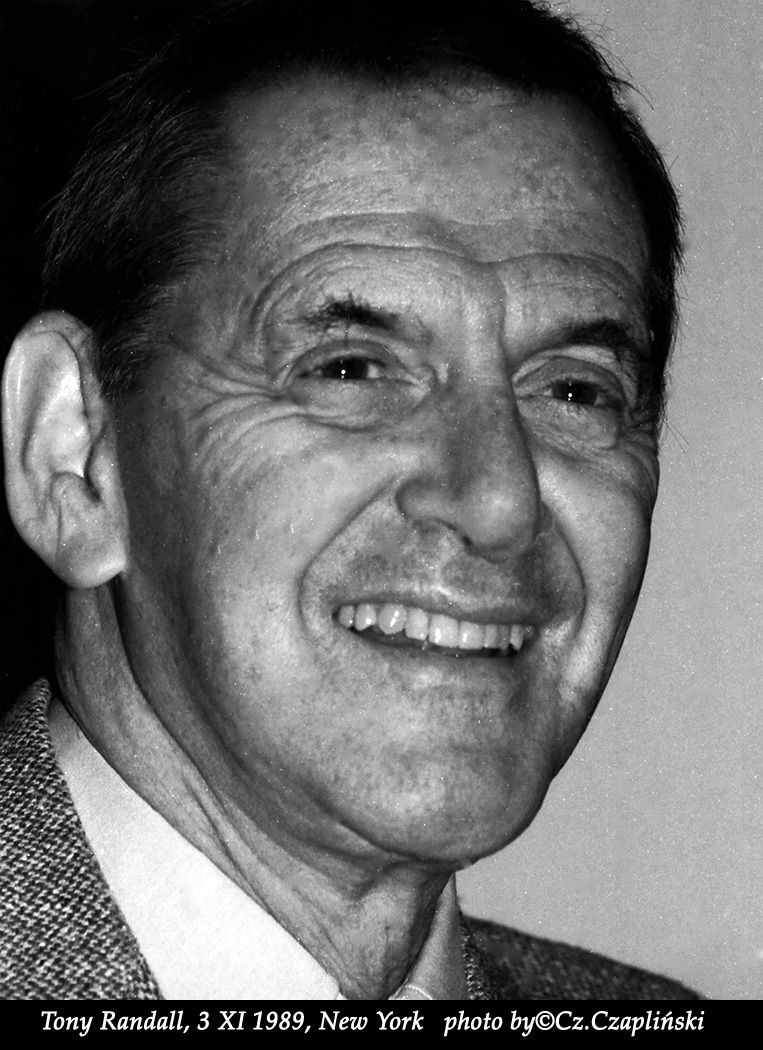
„…Tony Randalla spotkałem i fotografowałem 3 listopada 1989 r. w Nowym Jorku, gdy na Broadwayu miał swoją produkcję „M.Butterfly”, to było wielkie wydarzenie…” – Czesław Czapliński.

W 1991 roku założył National Actors Theatre, działający przy Pace University w Nowym Jorku. Teatr wystawiał m.in. „The Crucible”, „The Seagull”, „Saint Joan”, „The Government Inspector” i „The Gin Game”. W 1997 roku z wielkim sukcesem zagrał w „The Sunshine Boys” wraz z Klugmanem.We wrześniu 1993 roku obaj aktorzy ponownie wcielili się w swoje role w filmie telewizyjnym „The Odd Couple: Together Again”.
Randall był częstym gościem programu „The Tonight Show Starring Johnny Carson” i wielokrotnie opowiadał o swojej miłości do opery. W chwili śmierci wystąpił w tym programie aż 105 razy — częściej niż jakikolwiek inny celebryta.
Był także stałym panelistą teleturnieju „What’s My Line?” (1958–1967) oraz uczestnikiem programów „Password”, „The Hollywood Squares” i „Pyramid”. Wystąpił gościnnie w „The Muppet Show” (1980) oraz w pierwszym odcinku „Late Night with Conan O’Brien” w 1993 roku.
W 1990 roku użyczył głosu postaci Brain Gremlina w filmie „Gremlins 2: The New Batch”.
Jego późniejsze role filmowe obejmowały m.in. „Fatal Instinct” (1994) i „Down with Love” (2003). Ostatnie występy sceniczne miał w „The Resistible Rise of Arturo Ui” (2002) i „Right You Are” (2003).
Randall był żonaty ze swoją szkolną miłością Florence Gibbs od 1938 roku aż do jej śmierci w 1992 roku; nie mieli dzieci. W 1995 roku, w wieku 75 lat, poślubił 25-letnią Heather Harlan. Para miała dwoje dzieci: Julię (ur. 1997) i Jeffersona (ur. 1998) i pozostawała małżeństwem aż do jego śmierci.Mieszkał na Manhattanie i posiadał również apartament wakacyjny w Key Biscayne na Florydzie.

Randall był znany jako znakomity gawędziarz i współautor książki „Which Reminds Me” (1989), zawierającej anegdoty ze świata show-biznesu. Był również narratorem kilku produkcji wideo Metropolitan Opera w latach 80.Był gorącym orędownikiem sztuki — latem 1980 roku pełnił rolę gospodarza koncertów New York Philharmonic w Central Parku.
Politycznie był liberałem. Aktywnie wspierał Eugene’a McCarthy’ego w prawyborach Partii Demokratycznej w 1968 roku oraz George’a McGoverna w 1972 roku. Z powodu sprzeciwu wobec wojny w Wietnamie usunięto go z roli panelisty w radiowych transmisjach Metropolitan Opera; pozostałą część wynagrodzenia przekazał na kampanię McCarthy’ego. Jego nazwisko znalazło się także na liście politycznych przeciwników Richarda Nixona.
Anthony Randall zmarł we śnie 17 maja 2004 roku w NYU Medical Center na zapalenie płuc, które rozwinęło się po operacji pomostowania aortalno-wieńcowego w grudniu 2003 roku. Od czasu operacji przebywał w szpitalu. Został pochowany na cmentarzu Westchester Hills Cemetery w Hastings-on-Hudson w stanie Nowy Jork
„…Najważniejsze jest to, że te sztuki powinno się oglądać w teatrze. Po to zostały napisane. Tam tkwi przyjemność. Studiowanie ich nie daje żadnej przyjemności…” — Tony Randall
PORTRAIT with HISTORY Anthony Randall

“…Marilyn Monroe was no fun to work with. She would report to work around 5:00 in the evening. You've been in make-up since 8:30 in the morning waiting for her…” – Tony Randall.
Anthony Leonard Randall (born Aryeh Leonard Rosenberg; February 26, 1920 – May 17, 2004) was an American actor, comedian, director, producer and singer, active in film, television and stage.
He is best known for portraying the role of Felix Unger in the 1970–1975 television adaptation of the 1965 play The Odd Couple by Neil Simon. In a career spanning six decades, Randall received six Golden Globe Award nominations and six Primetime Emmy Award nominations, winning one Emmy.
Randall was born to a Jewish family in Tulsa, Oklahoma, the son of Julia (née Finston) and Mogscha Rosenberg, an art and antiques dealer. He attended Tulsa Central High School.
Randall attended Northwestern University for a year, he studied speech and drama, before going to New York City to study at the Neighborhood Playhouse School of the Theatre. He studied under Sanford Meisner and choreographer Martha Graham. Randall worked as an announcer at radio station WTAG in Worcester, Massachusetts. As Anthony Randall, he starred with Jane Cowl in George Bernard Shaw's Candida and Ethel Barrymore in Emlyn Williams's The Corn Is Green.

Randall served for five years with the U.S. Army Signal Corps during World War II, including work at Arlington Hall for the codebreaking Signal Intelligence Service.: He rose to the rank of first lieutenant prior to his discharge.
After the war, he worked at the Olney Theatre in Montgomery County, Maryland, before heading back to New York City.
One of Randall's first acting jobs was as the character Reggie York in the 1949-1952 revival of the radio adventure series I Love a Mystery.
In 1946, Randall was cast as one of the brothers in a touring production of Katharine Cornell's revival of The Barretts of Wimpole Street.
Randall appeared on Broadway in Cornell's production of Antony and Cleopatra (1947–48) with Cornell, Charlton Heston, and Maureen Stapleton, and in Caesar and Cleopatra (1949–50) with Cedric Hardwicke and Lilli Palmer. Randall began appearing on television, notably episodes of One Man's Family.
Randall's first major television role was as history teacher Harvey Weskit in Mister Peepers (1952–1955). He continued to guest-star on other shows such as The Gulf Playhouse (directed by Arthur Penn), The Pepsi-Cola Playhouse, Kraft Theatre, The Motorola Television Hour, Armstrong Circle Theatre, Studio One in Hollywood, Appointment with Adventure, and The Philco-Goodyear Television Playhouse.
“…There's only one thing worse than a man who doesn't have strong likes and dislikes, and that's a man who has strong likes and dislikes without the courage to voice them…” – Tony Randall

Randall replaced Gig Young in the Broadway hit Oh, Men! Oh, Women! (1954).
Randall's first major role in a Broadway hit was in Inherit the Wind (1955–1957), portraying newspaperman E. K. Hornbeck (based on real-life cynic H. L. Mencken), alongside Ed Begley and Paul Muni. On television he appeared in Heaven Will Protect the Working Girl (1956), co-written by Neil Simon. He also guest-starred on The Alcoa Hour.
Randall's success in Inherit the Wind led to film offers and his first significant big-screen role in Oh, Men! Oh, Women! (1957) for 20th Century Fox, which promoted Randall to stardom with Will Success Spoil Rock Hunter? (1957) alongside Jayne Mansfield. He played one of the leads in No Down Payment (1957). He was replaced with Dean Martin shortly before the filming of Fox's The Young Lions.
In 1958, Randall played the leading role in the Broadway musical comedy Oh, Captain!, taking on a role originated on film by Alec Guinness. The show was a financial failure, but Randall received a Tony Award nomination for his dance turn with prima ballerina Alexandra Danilova.

Randall appeared in Westinghouse Desilu Playhouse, Goodyear Theatre, The United States Steel Hour, Sunday Showcase and Playhouse 90.
Randall co-starred with Debbie Reynolds in The Mating Game (1959) at Metro-Goldwyn-Mayer. He appeared in the hit film Pillow Talk (1959) supporting Doris Day and Rock Hudson, for which he was nominated for a Golden Globe Award for Best Supporting Actor. He would reunite with Day and Hudson for two more films, Lover Come Back(1961), which earned him another Golden Globe Best Supporting Actor nomination, and Send Me No Flowers (1964).
Randall starred in an NBC-TV special, The Secret of Freedom, which was filmed during the summer of 1959 in Mount Holly, New Jersey, and broadcast on the network during the fall of 1959 and again in early 1960. On TV he was also in The Man in the Moon (1960), co-written by Mel Brooks. Randall was top-billed in The Adventures of Huckleberry Finn from MGM in 1960. He had a Pillow Talk-style supporting role in Let's Make Love (1960) with Marilyn Monroe and Yves Montand, and Lover Come Back (1961) with Hudson and Day. Randall continued to guest on TV shows including General Electric Theater and Checkmate. In 1961, Randall played a highly dramatic role in "Hangover," an episode of The Alfred Hitchcock Hour in which he portrayed an alcoholic advertising executive spiraling into self-destruction. He starred in a TV adaptation of Arsenic & Old Lace (1962), and had big-screen leading roles in Boys' Night Out (1962) and Island of Love(1963).
In 1964, Randall starred in the classic MGM film, 7 Faces of Dr. Lao, which was based on The Circus of Dr. Lao by Charles G. Finney. In addition to portraying and voicing the eponymous seven faces (Dr. Lao, the Abominable Snowman, Merlin, Apollonius of Tyana, The Giant Serpent, Pan, and Medusa), Randall also appeared without makeup in a two-second cameo as a solemn spectator in the crowd, for a total of eight roles in the film.
He played the lead in The Brass Bottle (1964) and made one last film with Hudson and Day, Send Me No Flowers (1964). Randall took the lead in Fluffy (1965), a comedy about a lion; The Alphabet Murders (1965), playing Hercule Poirot for Frank Tashlin; Our Man in Marrakesh (1966), as a secret agent; and Hello Down There (1969).

Randall returned to Broadway in UTBU (1966), which had only a short run. He appeared in the TV movie The Littlest Angel (1969) with Johnny Whitaker and Fred Gwynne.
Randall returned to television in 1970 as Felix Unger in The Odd Couple, opposite Jack Klugman, a role that lasted five years. The names of Felix's children in The Odd Couple were Edna and Leonard, named for Randall's sister and Randall himself.
In 1974, Randall and Klugman appeared in television spots endorsing a Yahtzeespinoff, Challenge Yahtzee. They appeared in character as Felix and Oscar, and the TV spots were filmed on the set of The Odd Couple.
During the series run, Randall took a small role in Everything You Always Wanted to Know About Sex (But Were Afraid to Ask) (1972).
In 1973, he was hired to play the voice of Templeton the gluttonous rat in Charlotte's Web, and recorded the part, but was replaced in the film by Paul Lynde. Randall's voice was perceived as too sophisticated by co-director Iwao Takamoto, who wanted Templeton to have a nasal voice.

Beginning in 1976, Randall starred for two seasons in The Tony Randall Show, playing Philadelphia judge Walter Franklin. He had roles in Kate Bliss and the Ticker Tape Kid (1978), Scavenger Hunt (1979), and Foolin' Around (1980).
Randall starred in the NBC series Love, Sidney from 1981 to 1983. In the TV movie that served as the show's pilot, Sidney Shorr: A Girl's Best Friend, Sidney Shorr was written as a middle-aged homosexual man; the character's sexuality was made ambiguous for the series. After the show was canceled in 1983, Randall refused to star in another television series, favoring the Broadway stage as his medium.
Randall continued to appear in TV movies. He starred in Sunday Drive (1986) for Disney, Save the Dog! (1988), and The Man in the Brown Suit (1989). From October 30 to November 2, 1987, he hosted the free preview of HBO's short-lived premium channel Festival.
In 1989, Randall returned to Broadway as a replacement in M. Butterfly.
„…I met and photographed Tony Randall on November 3, 1989, in New York, when he had his production of ‘M. Butterfly’ on Broadway — it was a major event…” – Czesław Czapliński.

In 1991, Randall founded the National Actors Theatre, ultimately based at Pace University in New York City. Their productions included The Crucible (1991), A Little Hotel on the Side (1992), The Master Builder (1992), The Seagull (1992), Saint Joan(1993), Three Men on a Horse (1993), Timon of Athens (1993), The Government Inspector(1993), The Flowering Peach (1994), Gentlemen Prefer Blondes (1994), The School for Scandal (1995), Inherit the Wind (1996), and The Gin Game (1997). In 1997, he performed in The Sunshine Boys with Klugman to great success.
In September 1993, Randall and Klugman reunited in the CBS-TV movie The Odd Couple: Together Again, reprising their roles. The story began when, after Felix ruined plans for his daughter Edna's wedding, his wife Gloria threw him out of the house for 11 days, which left him no choice but to move back in with Oscar and to help him recover, getting him back in shape after throat cancer surgery had left his voice very raspy.
Randall in 2001 Randall's later stage productions included Night Must Fall (1999) and Judgment at Nuremberg (2001).
Periodically, he performed in stage revivals of The Odd Couple with Klugman, including a stint in London in 1996. Later film roles included Fatal Instinct (1994) and Down with Love (2003).
Randall's last appearances on stage as an actor were in The Resistible Rise of Arturo Ui (2002) and Right You Are (2003).
On September 4, 1955, Randall and Klugman appeared together with Gena Rowlands in the episode "The Pirate's House" of the CBS anthology series Appointment with Adventure.
Randall was a frequent guest on The Tonight Show Starring Johnny Carson and often spoke of his love of opera and the salaciousness of many of its plotlines. He also admitted to sneaking tape recorders into operas to make his own private recordings. He chided Johnny Carson for his chain smoking and was generally fastidious. At the time of his death, Randall had appeared as a guest on The Tonight Show 105 times, more often than any other celebrity had appeared.
Randall was well-known for being a guest panelist on the game show What’s My Line? from1958 to 1967, Password, The Hollywood Squares, and the $10,000 and $20,000 Pyramids. He also parodied his pompous image with an appearance as a "contestant" on The Gong Show in 1977.
Randall was a guest star on the fifth and final season of The Muppet Show in an episode that first aired on October 11, 1980. This was the 100th episode of the show.
Randall, along with John Goodman and Drew Barrymore, was among the first guests on the debut episode of Late Night with Conan O'Brien on September 13, 1993. He would also appear in Conan O'Brien's 5th Anniversary Special with the character PimpBot 5000. Randall was a frequent guest as well on both of David Letterman's late-night shows Late Night with David Letterman and the Late Show with David Letterman, making 70 appearances, according to his obituary in The Washington Post. Letterman said that Randall was one of his favorite guests, along with Regis Philbin.
On November 7, 1994, Randall appeared on the game show Jeopardy!, as part of a celebrity episode, playing on behalf of the National Actors Theatre. He came in second place behind General Norman Schwarzkopf Jr. but ahead of actress Stefanie Powers, with a final tally of $9,900.
In 1973, Randall and Klugman recorded an album for London Records titled The Odd Couple Sings. Roland Shaw and the London Festival Orchestra and Chorus provided the accompaniment and additional vocals. The record was not a chart-topper but is a highly sought-after item for many Odd Couple fans. Randall and Klugman also collaborated on a series of television commercials for Eagle brand snacks.
A noted raconteur, Randall, along with co-writer Mike Mindlin, wrote a collection of amusing and sometimes racy show business anecdotes called Which Reminds Me, published in 1989.
In keeping with his penchant for both championing and mocking the culture that he loved, during the Big Band-era revival in the mid-1960s, Randall produced a record album of 1930s songs, Vo, Vo, De, Oh, Doe, inspired by (and covering) the New Vaudeville Band's one-hit wonder, "Winchester Cathedral." He mimicked (and somewhat exaggerated) the vibrato style of Carmen Lombardo, and the two had once sung a duet of Lombardo's signature song "Boo Hoo (You've Got Me Crying for You)" on The Tonight Show.
In the 1980s, Randall served as off-camera narrator for several video productions by the Metropolitan Opera, announcing performers to the television audience as they appeared on stage during curtain calls and providing brief descriptions of scenes.
For the 1990 sequel Gremlins 2: The New Batch, Randall voiced the Brain Gremlin.
Randall's footstone in Westchester Hills Cemetery Randall was married to his high school sweetheart, Florence Gibbs, from 1938 until her death from cancer on April 18, 1992. They had no children. On November 17, 1995, at the age of 75, he married 25-year-old Heather Harlan, an understudy from the production of The School for Scandal in which Randall was starring, at National Actors Theatre; the ceremony was officiated by Rudy Giuliani. They lived in a Manhattan apartment and bought a vacation apartment in Key Biscayne, Florida, in 2003. The couple had two children, Julia, born on April 11, 1997, and Jefferson, born on June 15, 1998, and remained married until Randall's death in May 2004.
In his book Which Reminds Me, Randall maintained that any publicity that an actor generates should be about his work, not himself: "The public knows only one thing about me: I don't smoke."
Randall was an advocate for the arts. During the summer of 1980, he served as the celebrity host of the New York Philharmonic Orchestra's concerts in Central Park, New York City.
Randall was politically liberal. He was an active supporter of Eugene McCarthy during the 1968 Democratic Party presidential primaries. When he was dropped as a regular panelist on the Opera Quiz intermission feature of the Metropolitan Opera radio broadcasts because of his opposition to the Vietnam War, he donated the remainder of his contract fee to the McCarthy campaign. During the U.S. presidential primaries in 1972, he appeared as the featured celebrity at numerous fundraising house parties for Democratic Party candidate George McGovern. His name was featured on the master list of Richard Nixon's political opponents.
Death Randall died in his sleep on May 17, 2004, at NYU Medical Center of pneumonia that he had contracted following coronary bypass surgery in December 2003. He had been hospitalized since the operation. His remains are interred at the Westchester Hills Cemetery in Hastings-on-Hudson, New York.
“…The real thing is, you should be seeing these plays in the Theatre. That's what they were written for. That's where the enjoyment is. Studying them is no enjoyment whatsoever…”– Tony Randall.


Komentarze