PORTRET z HISTORIĄ Luciano Pavarotti

Zaktualizowano: 14 sie

Luciano Pavarotti (1935-2007) tenor liryczny /lyric tenor, uważany za jednego z najwybitniejszych śpiewaków XX wieku. Kariera, urodzonego w 1935 roku w Modenie – małej miejscowości w północnych Włoszech, Luciano Pavarottiego przebiegała bez większych sensacji. Już z lat młodzieńczych wyniósł podstawy śpiewu. Ojciec jego, Fernando, z zawodu piekarz, amatorsko śpiewał jako tenor i wprowadził syna do kościelnego chóru. Kiedy Luciano miał 12 lat, ojciec zaprowadził go do znanego w całych Włoszech tenora, Beniamino Gigli, aby ten ocenił jego talent i dał wskazówki na przyszłość. Nie od razu jednak Luciano wszedł na drogę zawodowej kariery śpiewaka. W międzyczasie ukończył w 1955 roku, Instituto Magistrale w Modenie i uczył przez 2 lata w szkole podstawowej oraz był agentem ubezpieczeniowym.
To jednak nie zadawalało artystycznej duszy młodzieńca wychowanego w otoczeniu muzyki i śpiewu. Po krótkim okresie wahania rzucił się ze zdwojoną energią w wir śpiewu. Najpierw uczył się pod okiem Arrigo Pola.
W wieku 26 lat wygrał międzynarodowy konkurs, gdzie śpiewał rolę Rudolfo z "La Boheme". Tą rolą debiutował 2 lata później w Covent Garden w Londynie, a w 1966 roku w La Scali w Mediolanie i w 1968 roku w Metropolitan Opera w Nowym Jorku. Można bez wahania powiedzieć, że rola Rudolfo otworzyła Pavarottiemu drogę na szeroki świat.
Śpiewaczka operowa Joan Sutherland i jej mąż, R.Bonynge, którzy usłyszeli Pavarottiego w 1963 roku w Covent Garden w Londynie i po tym występie zaproponowali mu wspólną turę koncertową po Australii. Potem posypały się oferty z całego świata
Oprócz występów w najważniejszych teatrach operowych świata, sławę przyniosły mu występy na Stadionie Wembley i Hyde Parku w Londynie, Medison Square Garden i Central Parku w Nowym Jorku, pod Wieżą Eiffla w Paryżu. Nagrał wiele płyt, które sprzedał w czasie swojej kariery w ponad 100 milionach.
Dochód ze swoich występów Pavarotti często przeznaczał na cele publiczne. W 1980 roku był marszałkiem Columbus Day Parade w Nowym Jorku i wystąpił z koncertem w Central Parku, który oglądało 150,000 ludzi. Całkowity dochód z tego koncertu przeznaczył dla ofiar trzęsienia ziemi we Włoszech. Innym razem, 2 miliony dolarów, które otrzymał za występ z Frankim Sinatrą w San Francisco, ofiarował na badania nad rakiem.
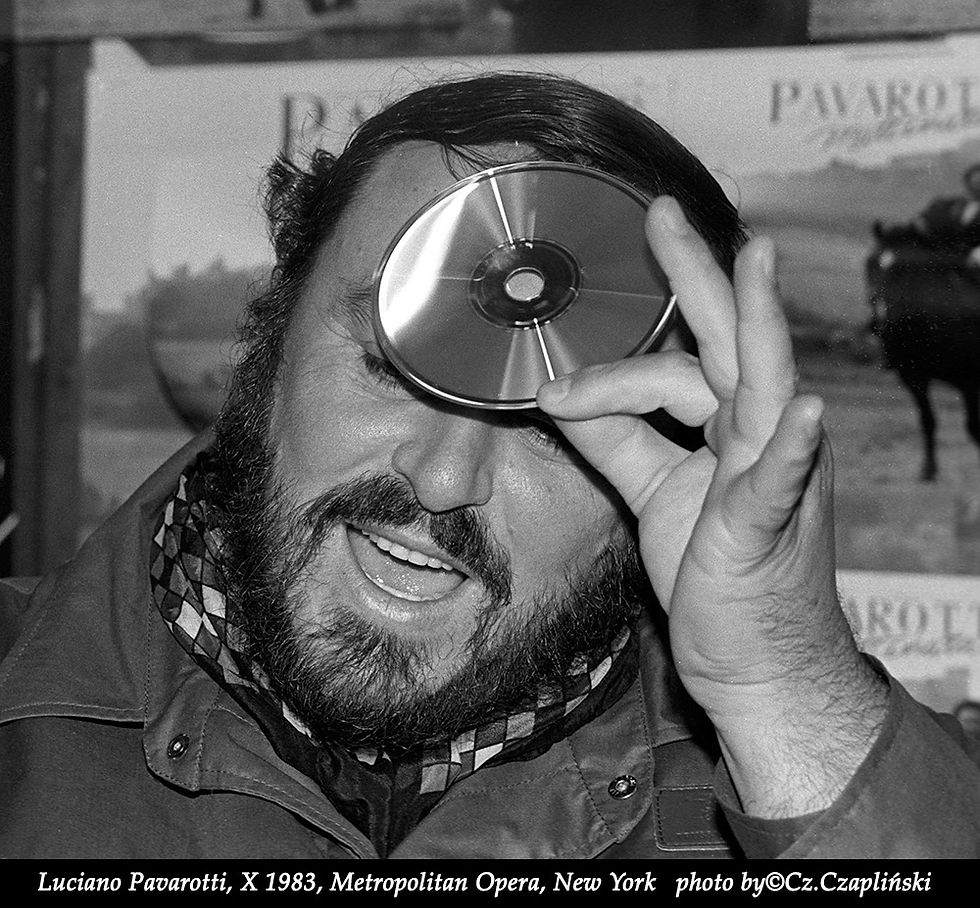
Przez 2-3 lata przyglądałem się Pavarottiemu z oddali w Metropolitan Opara, w Central Parku, aż tu nagle w październiku 1983 roku miałem możliwość spotakania go pierwszy raz TWARZĄ w TWARZ w MET w Nowym Jorku. Pamiętam pierwszy kontakt, byłem zaskoczony, nie zdawałem sobie sprawy jak potężny był Pavarotti, ponad 180 cm wzrostu, potężnej postury, niezwykle ruchliwy i dowcipny. Wchodziliśmy do budynku MET w Nowym Jorku, chciałem wejść pierwszy i tam mu zrobić zdjęcie. Przyspieszyłem kroku i wszedłem do przegrody kręconych drzwi, które nagle zatrzymały się, a do mojej części wszedł, może lepiej wepchął się Pavarotti, mówiąc musimy wciągnąć brzuchy. Udało się, ale było naprawdę ciasno. Kiedy już zrobiłem serię zdjęć, a atmosfera była dobra, pomyśłem, trzeba zrobić coś nietuzinkowego. Na stole leżała wyjęta płyta DVD, podalem ją Pavarottiemu, który bez namyslu przykleil są sobie do czoła. Musze powiedzieć, że tego bym nie wymyślił, a zdjęcie jest.

Na zdjęciach zrobionych tamtego dnia widać Pavarottiego w całej krasie jego osobowości. Takiego, jaki był. A był niezwykle roześmianym, promieniującym pozytywną energią człowiekiem. Wchodził roześmiany i wszyscy śmiali się wraz z nim. Emanował najwspanialszą, najczystszą radością życia. Uwielbiał proste przyjemności i uwielbiał dawać ludziom radość – zarówno swoim śpiewem, jak i jedzeniem, które umiał znakomicie przyrządzać. Podczas swojego tournée w Polsce mieszkał w hotelu Marriott i miał specjalnie urządzony apartament, w którym gotował. Wszyscy byli zachwyceni jedzeniem, które wychodziło spod jego ręki.
Oczywiście, uwielbiał też jeść, o czym świadczyła jego tusza. Pamiętam, jak się śmiał, że firmy produkujące środki odchudzające namawiają go na to, żeby schudł. Oferowano mu za to naprawdę olbrzymie pieniądze. – Nie zdają sobie sprawy – mówił – że to byłby koniec mojej kariery jako śpiewaka. Gdybym był chudy, nie mógłbym tak śpiewać, jak śpiewam.
A śpiewał tak, że ludzie robili wszystko, żeby zdobyć bilety na jego występy. Mimo odległych terminów i bajońskich cen. Ludzie potrafią spe- cjalnie przyjeżdżać do Nowego Jorku z drugiego końca świata na jakieś przedstawienie. Ale to jest Metropolitan.
Luciano Pavarotti był królem Metropolitan Opera. Występował tam przez wiele sezonów. Kto raz słuchał jego śpiewu na tej niezwykłej scenie, kto widział szaleństwo tłumów go oklaskujących – nie zapomni tego do końca życia.
Jeden z najwybitniejszych tenorów XX wieku.
Nie zapominajmy, że urodził się jako syn piekarza, występującego jednocześnie w operze w Modenie. Występował na najważniejszych scenach operowych świata – między innymi w La Scali, Metropolitan Opera. Razem z Plácido Domingo i José Carrerasem dawał słynne koncerty trzech tenorów. Niekwestionowany mistrz opery, śpiewak, filantrop (chętnie brał udział w akcjach charytatywnych), ale i skandalista – w 2003 roku wziął ślub z młodszą o 35 lat sekretarką, zostawiwszy dla niej żonę.
Luciano Pavarotti był nie tylko jednym z najsłynniejszych śpiewaków operowych, ale też postacią medialną na miarę największych gwiazd pop i showmanem, którego koncerty przyciągały jednorazowo kilkaset tysięcy osób. Luciano Pavarotti słynął ze swojego wysokiego C, jego znakiem rozpoznawczym była aria "Nessun Dorma" z opery "Turandot" Pucciniego.

Gdy śpiewał "O sole mio", już po pierwszych dźwiękach rozlegały się gromkie brawa. Pokazywany w telewizji słynny koncert trzech tenorów, który w 1990 roku odbył się w rzymskich termach Karakalli, wciąż przyciąga słuchaczy, a sprzedane w ciągu trzech miesięcy trzy miliony płyt i kaset z jego nagraniem uczyniło zeń niepokonany do dziś przebój fonograficzny.
Dwukrotnie Pavarotti znalazł się w Księdze Guinnesa. Jest artystą, który najwięcej razy wracał na scenę wskutek owacji publiczności, a jego album nagrany z Plácido Domingo i José Carrerasem („The Three Tenors In Concert”) jest najlepiej sprzedającą się płytą z muzyką klasyczną.
Opera to niezwykły świat. A mekką tego świata jest nowojorska Metropolitan Opera. Siedząc tam, nawet ja – osoba, która nie jest szczególnie podatna na magię muzyki – czuję, że uczestniczę w czymś niezwykłym, magicznym i absolutnie niepowtarzalnym.
Fotografowałem wszystkie polskie gwiazdy, które śpiewały na deskach Metropolitan Opera. Pierwszą z nich była bardzo często tam występująca Teresa Żylis-Gara. Potem portretowałem jej imienniczkę, Teresę Kubiak, Wiesława Ochmana i wielu, wielu innych.

PORTRAIT with HISTORY Luciano Pavarotti (1935-2007)
Luciano Pavarotti (1935–2007), a lyric tenor, is considered one of the greatest singers of the 20th century. The career of Luciano Pavarotti, born in 1935 in Modena—a small town in northern Italy—developed without any major sensation or controversy. He acquired the foundations of singing during his youth. His father, Fernando, a baker by profession, sang as an amateur tenor and introduced his son to the church choir. When Luciano was 12, his father took him to Beniamino Gigli, a tenor well known throughout Italy, so that he could assess his talent and offer advice for the future. However, Luciano did not immediately embark on a professional singing career. In the meantime, in 1955 he graduated from the Instituto Magistrale in Modena and taught at an elementary school for two years. He also worked as an insurance agent.

Yet this did not satisfy the artistic soul of the young man who had grown up surrounded by music and singing. After a brief period of hesitation, he threw himself into singing with renewed energy. At first, he studied under Arrigo Pola.
At the age of 26, he won an international competition, where he sang the role of Rodolfo in La Bohème. Two years later, he made his debut in that role at Covent Garden in London, followed by his debut at La Scala in Milan in 1966 and at the Metropolitan Opera in New York in 1968. It can be said without hesitation that the role of Rodolfo opened the door to the wider world for Pavarotti.

Opera singer Joan Sutherland and her husband, R. Bonynge, heard Pavarotti in 1963 at Covent Garden in London and, following that performance, invited him to join them on a concert tour of Australia. After that, offers began pouring in from all over the world.
In addition to performing at the world's most important opera houses, he gained enormous fame through appearances at Wembley Stadium and Hyde Park in London, Madison Square Garden and Central Park in New York, and beneath the Eiffel Tower in Paris. He recorded numerous albums, which sold more than 100 million copies during his career.

Pavarotti often donated the proceeds from his performances to charitable causes. In 1980, he served as Grand Marshal of the Columbus Day Parade in New York and gave a concert in Central Park attended by 150,000 people. He donated the entire proceeds from that concert to the victims of the earthquake in Italy. On another occasion, he donated the $2 million he received for a performance with Frank Sinatra in San Francisco to cancer research.

For two or three years I watched Pavarotti from a distance at the Metropolitan Opera and in Central Park, until suddenly, in October 1983, I had the opportunity to meet him face-to-face for the first time at the MET in New York. I remember that first encounter. I was surprised—I had not realized how physically imposing Pavarotti was. He was over 180 cm tall, powerfully built, extraordinarily lively and witty.
We were entering the MET building in New York. I wanted to go in first and take his photograph there. I quickened my pace and stepped into one section of the revolving door, which suddenly stopped. Pavarotti entered—or perhaps better said, squeezed himself—into my section, saying, “We have to suck in our stomachs.” We managed it, but it was really tight.
After I had taken a series of photographs and the atmosphere was good, I thought, We have to do something unusual.There was a DVD lying on the table. I handed it to Pavarotti, and without hesitation he stuck it to his forehead. I have to say, I could never have come up with that myself—and the photograph exists.
The photographs I took that day show Pavarotti in all the richness of his personality. They show him exactly as he was: an extraordinarily cheerful man, radiating positive energy. He would enter laughing, and everyone around him would laugh with him. He radiated the most wonderful, pure joy of life.

He loved simple pleasures, and he loved bringing joy to people—both through his singing and through food, which he knew how to prepare exceptionally well. During his tour of Poland, he stayed at the Marriott Hotel and had a specially arranged suite where he cooked. Everyone was delighted with the food he prepared.
Of course, he also loved to eat, as his considerable weight clearly showed. I remember how he laughed about companies that manufactured weight-loss products trying to persuade him to lose weight. They offered him truly enormous sums of money to do so.
“They don't realize,” he said, “that it would be the end of my career as a singer. If I were thin, I couldn't sing the way I sing.”
And he sang in such a way that people did everything possible to obtain tickets to his performances, despite the distant dates and astronomical prices. People would even travel to New York from the other side of the world specifically to attend a particular performance. But this is the Metropolitan.
Luciano Pavarotti was the king of the Metropolitan Opera. He performed there for many seasons. Anyone who once heard him sing on that extraordinary stage, who witnessed the frenzy of the crowds applauding him, would never forget it for the rest of their life.
One of the greatest tenors of the 20th century.
Let us not forget that he was born the son of a baker who also performed in opera in Modena. He went on to perform on the world's most important opera stages, including La Scala and the Metropolitan Opera. Together with Plácido Domingo and José Carreras, he gave the famous Three Tenors concerts. An unquestioned master of opera, a singer and philanthropist—he willingly took part in charitable causes—but also a controversial figure: in 2003, he married his secretary, who was 35 years younger than he was, leaving his wife for her.

Luciano Pavarotti was not only one of the most famous opera singers, but also a media personality on the scale of the greatest pop stars and a showman whose concerts could attract several hundred thousand people at a time. Luciano Pavarotti was famous for his high C, and his signature aria was “Nessun Dorma” from Puccini's opera Turandot.
When he sang “O Sole Mio,” thunderous applause would erupt after the very first notes. The famous televised Three Tenors concert, held in 1990 at the Baths of Caracalla in Rome, continues to attract listeners, and the three million records and cassettes of the recording sold within three months made it an unprecedented recording-industry hit that remains unmatched to this day.
Pavarotti entered the Guinness Book of Records twice. He holds the record for the most curtain calls in response to audience ovations, while his album recorded with Plácido Domingo and José Carreras, The Three Tenors in Concert, is the best-selling classical music album.
Opera is an extraordinary world. And the Mecca of this world is New York's Metropolitan Opera. Sitting there, even I—a person who is not particularly susceptible to the magic of music—feel that I am taking part in something extraordinary, magical, and absolutely unique.
I photographed all the Polish stars who sang on the stage of the Metropolitan Opera. The first was Teresa Żylis-Gara, who performed there very frequently. Later, I photographed her namesake, Teresa Kubiak, as well as Wiesław Ochman and many, many others.


Komentarze