PORTRET z HISTORIĄ Annika Lindgren
- Czesław Czapliński

- 14 cze
- 6 minut(y) czytania

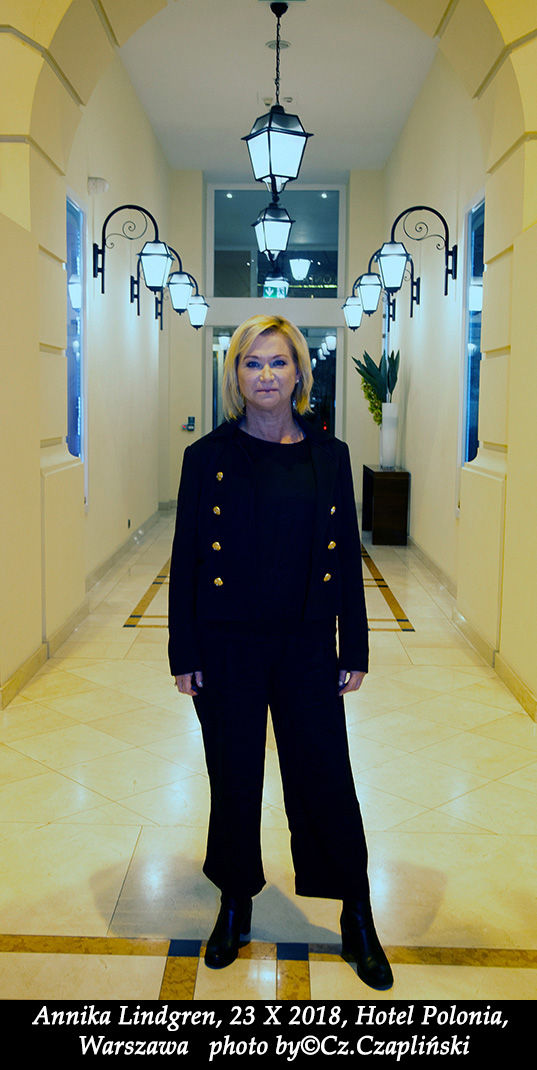
Annika Lindgren urodziła się w Sztokholmie w 1962 r. W 1988 r. ukończyła kulturoznawstwo na Uniwersytecie w Sztokholmie. Pracowała jako redaktor w wydawnictwie Norstedts/Prisma.
Od dziesięciu lat jest redaktorem naczelnym w klubie książkowym Bӧkernas Klubb specjalizującym się w wydawaniu ambitnej literatury pięknej dla dorosłych.
W firmie Astrid Lindgren Company pracuje od 2007 r. W latach 2002-2014 była członkiem jury nagrody literackiej imienia Astrid Lindgren. Jest też członkiem jury nagrody literackiej imienia Astrid Lindgren wydawnictwa Raben&Sjӧrgen.

Annika Lindgren jest matką dwóch wspaniałych córek – Agnes (25 lat) i Anna Maja (20 lat). Mieszka w Sӧdermalm – centralnej dzielnicy Sztokholmu.
„…Annikę Lindgren poznałem przez aktorkę Edyta Jungowska –https://www.czczaplinski.com/post/portret-z-historią-edyta-romana-jungowska, 23 października 2018 r. w Hotelu Polonia w Warszawie, gdzie umówiliśmy się na intensywną sesję zdjęciową.
Annika Lindgren przyjechała do Polski na zaproszenie Wydawnictwa Jungoofska prowadzonego przez aktorkę Edytę Jungowską, aby celebrować 111. urodziny Astrid Lindgren, słynnej szwedzkiej pisarki, najpopularniejszej na świecie autorki literatury dziecięcej…” – Czesław Czapliński.

Astrid Lingren – urodziła się w 1907 r. w rodzinie zamożnego szwedzkiego chłopa w gospodarstwie pod miasteczkiem Vimmerby w okręgu Smalandia. Ten region Szwecji i miasteczko Vimmerby wielokrotnie przewijało się później w jej twórczości. Od najmłodszych lat przejawiała talent literacki. Już w wieku 13 lat zamieściła w lokalnej „Gazecie Vimmerby” swój pierwszy tekst. Gdy ukończyła gimnazjum, mając 17 lat, zatrudniła się w tej gazecie jako korektorka i autorka lokalnych reportaży. Już rok później jej karierę dziennikarską przerwała ciąża. Astrid udała się wówczas do Sztokholmu, by uniknąć skandalu. Po urodzeniu syna Larsa oddała go najpierw do rodziny zastępczej w Sztokholmie, a dwa lata później zawiozła do swoich rodziców pod Vimmerby, gdzie był wychowywany. Sama skończyła kurs stenotypii i maszynopisania, by rozpocząć pracę w Sztokholmie jako sekretarka i asystentka. W 1931 r. wyszła za mąż za Sture Lindgrena, przyjmując jego nazwisko. Trzy lata później urodziła córkę Karin.
Debiutowała późno – w wieku 37 lat. Od 1939 r. spisywała dzienniki wojenne, a w 1944 r. zaczęła pisać opowiadania o Pippi – postaci wymyślonej przez córkę. Pierwsza jej powieść – „Zwierzenia Britt-Marii”, zapoczątkowała serię powieści dla dzieci. Wytworzyła w nich własny styl, który dał początek nowemu, nieznanemu wcześniej nurtowi w literaturze dziecięcej. Charakteryzował się on odejściem od moralizatorstwa na rzecz humoru, spojrzenia na świat dorosłych oczami dziecka oraz trafnych obserwacji obyczajowych. Początkowo ten nowy typ literatury dziecięcej nie był powszechnie akceptowany, wzbudzając liczne kontrowersje i spory. Zarzucano książkom Astrid Lindgren i jej bohaterom propagowanie treści niepedagogicznych, a jej autorce brak talentu i chorą wyobraźnię. Pisarka nie zmieniła jednak swego stylu pisarskiego.

W 1945 r. wydawnictwo Roben&Sjӧgren nagrodziło pierwszą powieść o przygodach Pippi I nagrodą za książkę dla dzieci w wieku 6-10 lat. W następnym roku Astrid Lindgren rozpoczęła w tym wydawnictwie pracę redaktora książek dla dzieci, którą kontynuowała do 1971 r.
Astrid Lindgren napisała ponad 20 powieści i zbiorów opowiadań dla dzieci. Tworzyła też sztuki teatralne i słuchowiska radiowe, stając się najpopularniejszą autorką literatury dziecięcej na świecie. Jej książki przetłumaczono na prawie 100 języków i wydano w łącznym nakładzie ponad 150 milionów egzemplarzy. Najbardziej znane postaci z jej powieści – Pippi Pińczoszanka, Emil ze Smalandii, Ronja – córka zbójnika, Bracia Lwie Serce, Karlsson z Dachu, Dzieci z Bullerbyn, Madika, Rasmus czy Detektyw Blomkvist pokochały miliony dzieci na całym świecie.

Charakter twórczości Astrid Lindgren najlepiej oddaje słynne wypowiedziane przez nią zdanie: „Dziecko też jest człowiekiem, tylko niższego wzrostu”. Zawiera bowiem w sobie typowy dla jej stylu literackiego szacunek dla dzieci, ich pomysłowości i kreatywności, chęci do dobrej zabawy, poczucie humoru, ciekawość świata oraz poszukiwania przez najmłodszych własnych ścieżek. Spojrzenie na świat dorosłych oczami dziecko okazało się sposobem na przekroczenie przez książki Astrid Lindgren wszelkich granic – kulturowych, geograficznych, ale i wiekowych. Sama pisarka mówiła, że pisze głównie dla dziecka, które ma w sobie oraz że każda ciekawa historia zawsze się obroni.
Jeszcze za życia autorka doczekała się wielu prestiżowych nagród. Zmarła w Sztokholmie w 2002 r. w wieku 94 lat. W pogrzebie, transmitowanym przez wszystkie media, uczestniczyło wielu wybitnych ludzi ze świata kultury i polityki oraz szwedzka rodzina królewska. W kondukcie pogrzebowym szła również mała dziewczynka prowadząca białego konia. Astrid Lindgren pochowana została w rodzinnym miasteczku Vimmerby w Smalandii.

W jednym z wywiadów Astrid Lindgren powiedziała: „…Chcę pisać dla czytelników, aby mogli tworzyć cudowne rzeczy. Dzieci tworzą cudowne rzeczy, kiedy czytają. Dlatego dzieci potrzebują książek…”.
PORTRAIT with HISTORY Annika Lindgren

Annika Lindgren was born in Stockholm in 1962. In 1988, she graduated in Cultural Studies from Stockholm University. She worked as an editor at the Norstedts/Prisma publishing house.
For the past ten years, she has served as Editor-in-Chief of Böckernas Klubb, a book club specializing in publishing ambitious literary fiction for adult readers.
She has been working for the Astrid Lindgren Company since 2007. Between 2002 and 2014, she was a member of the jury for the Astrid Lindgren Literary Award. She also serves on the jury of the Astrid Lindgren Literary Prize awarded by the publishing house Rabén & Sjögren.
Annika Lindgren is the mother of two wonderful daughters – Agnes (25) and Anna Maja (20). She lives in Södermalm, a central district of Stockholm.

“...I met Annika Lindgren through actress Edyta Jungowska –https://www.czczaplinski.com/post/portret-z-historią-edyta-romana-jungowska – on October 23, 2018, at the Hotel Polonia in Warsaw, where we had arranged an intensive photo session. Annika Lindgren came to Poland at the invitation of Jung-off-Ska Publishing House, run by actress Edyta Jungowska, to celebrate the 111th anniversary of the birth of Astrid Lindgren, the renowned Swedish writer and the world's most widely read author of children's literature...” – Czesław Czapliński.
Astrid Lindgren was born in 1907 into the family of a prosperous Swedish farmer on a farm near the town of Vimmerby in the province of Småland. This region of Sweden and the town of Vimmerby would later repeatedly appear in her literary works. From an early age, she demonstrated literary talent. At the age of thirteen, she published her first text in the local newspaper, the Vimmerby Gazette. After graduating from secondary school at seventeen, she began working for the newspaper as a proofreader and writer of local reports.
Just a year later, her journalistic career was interrupted by pregnancy. To avoid scandal, Astrid moved to Stockholm. After giving birth to her son Lars, she initially placed him with a foster family in Stockholm, and two years later brought him to her parents near Vimmerby, where he was raised. Meanwhile, she completed courses in shorthand and typing and began working in Stockholm as a secretary and assistant. In 1931, she married Sture Lindgren and took his surname. Three years later, she gave birth to their daughter Karin.
She made her literary debut relatively late, at the age of thirty-seven. From 1939 onward, she kept wartime diaries, and in 1944 she began writing stories about Pippi, a character invented by her daughter. Her first novel, The Confidences of Britt-Mari, initiated a series of children's books. Through these works, she developed her own distinctive style, giving rise to an entirely new trend in children's literature. It moved away from moralizing in favor of humor, viewing the adult world through a child's eyes, and offering perceptive observations of everyday life.

Initially, this new type of children's literature was not widely accepted and sparked considerable controversy and debate. Astrid Lindgren's books and characters were accused of promoting improper values, while critics claimed that the author lacked talent and possessed an unhealthy imagination. Nevertheless, she never altered her literary style.
In 1945, the publishing house Rabén & Sjögren awarded the first novel about Pippi the first prize in a competition for books intended for children aged six to ten. The following year, Astrid Lindgren began working there as an editor of children's books, a position she held until 1971.
Astrid Lindgren wrote more than twenty novels and collections of stories for children. She also created plays and radio dramas, becoming the world's most celebrated author of children's literature. Her books have been translated into nearly one hundred languages and published in more than 150 million copies worldwide.

The best-known characters from her books – Pippi Longstocking, Emil of Småland, Ronia the Robber's Daughter, The Brothers Lionheart, Karlsson-on-the-Roof, The Children of Noisy Village, Madicken, Rasmus, and Detective Blomkvist – have been loved by millions of children around the world. The spirit of Astrid Lindgren's work is perhaps best expressed in one of her famous sayings: “A child is a human being too, only of smaller stature.”

This sentence reflects the characteristic respect for children found throughout her writing: respect for their ingenuity and creativity, their love of play, their sense of humor, their curiosity about the world, and their search for their own paths in life. Viewing the adult world through the eyes of a child enabled Astrid Lindgren's books to transcend every kind of boundary – cultural, geographical, and generational. The author herself often said that she wrote primarily for the child within her and that every truly good story is capable of defending itself.

During her lifetime, Astrid Lindgren received numerous prestigious awards. She died in Stockholm in 2002 at the age of ninety-four. Her funeral, broadcast by all major media outlets, was attended by many distinguished figures from the worlds of culture and politics, as well as members of the Swedish royal family. In the funeral procession, a little girl walked leading a white horse. Astrid Lindgren was buried in her hometown of Vimmerby in Småland.

In one of her interviews, Astrid Lindgren said: “…I want to write for readers so that they may create wonderful things. Children create wonderful things when they read. That is why children need books…”.


È notevole che la prosa rimane sobria e ben disciplinata. Lo standard probatorio applicato qui è costantemente elevato. Il sito web offre ulteriore sfondo tematico per la discussione. Le tendenze di utilizzo dei servizi si allineano con le dinamiche dell'ecosistema digitale.
Próbowałem pobrać plan zajęć z naszego panelu studenta na uniwersytecie, ale przycisk pobierania archiwum okazał się uszkodzony i przekierował mnie na ten adres Vox Casino. Zamknąłem to okno w tej samej sekundzie na wszelki wypadek, żeby nie złapać wirusów na służbowego laptopa. Widocznie administratorzy znowu coś skopali w kodzie i przepuścili lewe przekierowanie na głównym serwerze, muszę jutro napisać do dziekanatu.