PORTRET z HISTORIĄ Zbigniew Rybczyński

Zaktualizowano: 15 sie

„…Wymyślono film, aby zarejestrować świat. Ale zauważono, że gdy się nagra więcej klatek, a potem odtworzy je z normalną szybkością, zobaczymy świat w zwolnionym tempie. Kamera, która miała tylko odtwarzać rzeczywistość, zaczęła widzieć o wiele więcej niż my widzimy…” – Zbigniew Rybczyński „Podróżnik do krainy niemożliwości” (2000).

Zbigniew Rubczyński – urodził się 27 stycznia 1949 r. w Łodzi. Ukończył liceum plastyczne w warszawskich Łazienkach. Przed rozpoczęciem studiów na wydziale operatorskim w PWSFTviT w Łodzi przez rok pracował w Studiu Miniatur Filmowych w Warszawie (1968). Od początku lat 70. współpracował jako operator m.in. z Andrzejem Barańskim, Piotrem Andrejewem, Grzegorzem Królikiewiczem, ale po dyplomie zajął się przede wszystkim animacją. W Studiu Małych Form Filmowych Se-Ma-For w Łodzi zrealizował kilka autorskich projektów m.in. „Plamuz” (1973, I Nagroda w kategorii filmów muzycznych na „Jazz Film Saloon”, Wrocław 1985), „Zupę” (1974, m.in. Golden Badge na MFF w Chicago, 1978), „Nową książkę” (1975, m.in. Nagroda Główna MFFK w Oberhausen), „Lokomotywę” (1976, „Brązowe Koziołki” na Festiwalu Filmów dla Dzieci w Poznaniu, 1977), „Święto” (1976, Nagroda Publiczności na Przeglądzie Filmów Krótkich DKF „Zygzakiem” w Warszawie 1977).
W 1980 r. powstało „Tango”, najważniejszy obraz w dorobku artysty. Jego nowatorstwo w formie i w sposobie narracji znakomicie oddają słowa Ryszarda Ciarka – „pamięć pokoju po jego lokatorach”. „Tango” obsypane nagrodami w 1981 r. (m.in. Grand Prix i Nagroda Publiczności na MFFA w Annecy, Nagroda Specjalna Jury na MFFK w Hueska, Nagroda FIPRESCI i Nagroda Klubów Filmowych FICC na MFFF w Oberhausen).

Film „Tango” – jest ośmiominutową niemą opowieścią o międzyludzkich zależnościach (do jednego pomieszczenia stopniowo wprowadza się 25 osób), będącą sumą matematycznych wyliczeń i niezwykłej wizji. Film sprawia wrażenie wytworu komputera, jest jednak w pełni dziełem rąk autora – kolejne sekwencje filmowane były klatka po klatce, wycinane i nakładane. Film obsypany został nagrodami w Europie i trafił za ocean.
The Oscar goes to...11 kwietnia 1983 r., podczas 55. gali wręczenia Academy Awards w Los Angeles wśród takich sław, jak Meryl Streep czy Ben Kingsley, padło nazwisko: Rybczyński.

Jak wiadomo, gala rozdania nagród Amerykańskiej Akademii Filmowej popularnie zwanych Oscarami transmitowana na cały świat z Kodak Theatre to jeden z największych show na świecie. Wszystko musi być dopięte na ostatni guzik. Nie ma miejsca na żadną prowizorkę. Pamiętam, że kiedyś Jerzy Kosiński miał wręczać nagrodę w jednej z kategorii. Na dwa tygodnie przed godziną zero stawił się na próbie. Wyszedł na scenę i przeczytał swoją kwestię z promptera. Po chwili wpadł zdenerwowany reżyser imprezy.
– Proszę pana, w jakim języku pan to powiedział? – Po angielsku – odpowiada odruchowo zdumiony Kosiński. – Ale całkowicie niezrozumiale – cedzi coraz bardziej zirytowany
reżyser. – Ale ja nie raz występowałem w telewizji – nie ustępuje Jurek. – Nie, nie proszę pana, to jest całkowicie niezrozumiałe. To są Oscary. Albo pan to przeczyta tak, żeby cały świat pana zrozumiał, albo mamy problem.
I Jurek, chcąc nie chcąc, musiał ćwiczyć. No niestety, tam nie było przebacz. „To są Oscary”, to jest Hollywood Dream. Trzeba się podporządkować. Każda sekunda na wizji jest bezcenna – bo widzi cię cały świat. Gwiazdy u progu kariery zrobiłyby wszystko dla kilku sekund na wizji podczas rozdania Oscarów.
Każda z osób, które są nominowane do nagrody, wcześniej przygotowuje się do uroczystości, na wypadek, gdyby została laureatem. Transmisja nadawana jest z kilkunastosekundowym opóźnieniem – w razie nieprzewidzianych w scenariuszu problemów. Daje to możliwość przykrycia obrazu z jednej kamery innym – z drugiej kamery.
Zbigniew Rybczyński, nominowany w 1983 roku za znakomity krótkometrażowy film animowany Tango, również został poinstruowany, jak ma się zachować na wypadek wygranej. Mówili mu to, co wszystkim: – Stary, masz tyle i tyle sekund, schodzisz ze sceny, jak ten i tamten dadzą ci znak. Jak tego nie zrobisz, będzie problem.
Zbigniewowi udało się wspomnieć o Lechu Wałęsie i "Solidarności".
To jednak nie koniec historii – kiedy zdenerwowany Zbigniew wyszedł z Kodak Theatre zapalić papierosa, zapomniał zaproszenia. Nie wziął też statuetki. Po skończeniu papierosa chciał wrócić. Na jego drodze stanęło kilku rosłych ochroniarzy.
Trudno się zresztą tym facetom dziwić. Jak by nie patrzeć, do najpilniej chyba w tym momencie strzeżonego budynku na świecie usiłował wejść facet bez przepustki, bez zaproszenia, mówiący w jakimś niezrozumiałym języku i krzyczący „Oscar, Oscar!” "I have Oscar, I speak German and Polish".
Finał był taki, że został powalony na ziemię, założone zostały mu kajdanki, bronił się kopiąc i laureat Oscara wylądował w więzieniu. I pewnie trochę by tam posiedział, póki sprawa by się nie wyjaśniła, gdyby nie Yola Czaderska-Hayek, propagatorka kultury polskiej w Stanach. W posiadłości Belvedere należącej do Yoli i jej męża (a kiedyś do samego Rudolfa Valentino!) zatrzymywała się masa osób z Polski w drodze po amerykański sukces. A Yola im tej gościny nie odmawiała.
To właśnie Yola towarzyszyła Zbigniewowi na gali. Kiedy długo nie wracał z papierosa, zaczęła się niepokoić. Okazało się, że Rybczyński znalazł się w więzieniu, w którym spędził noc, a wyciągnął go wujek Jan Rybczyński, który zapłacił 1000 dolarów bail bond, a Yola ... puściła tę wiadomość do publicznego obiegu. Nie ukrywajmy – bardzo to Zbigniewowi się przysłużyło. Yola wiedziała, co robi.
Kto by tam zwrócił, prócz Polaków oczywiście, uwagę na laureata w tak niepopularnej kategorii. Tego wieczoru Oscary za pierwszoplanowe role odbierali: zjawiskowa Meryl Streep za Wybór Zofii i Ben Kingsley – za brawurowo zagranego Gandhiego. To głównie o nich pisała prasa. No może jeszcze o E.T. A tak – dzięki nietypowemu zakończeniu wieczoru – nie na bankiecie, lecz na komisariacie – pisała również o Rybczyńskim. Sytuacja oczywiście była bardzo niezręczna, Zbigniew został natychmiast wypuszczony z aresztu i przeproszony, ale Bogiem a prawdą – znalazł się tam przecież nie bez powodu.
Oczywiście, nagrodę dostał też nie bez powodu. Tango jest fenomenalne. W dodatku wyprzedza swoją epokę – to, co potem robiono za pomocą technik komputerowych (nakładanie wielu obrazów na siebie), Zbigniew zrobił metodą analogową!
Również przekaz Tanga był genialny w swojej prostocie. Nie zdajemy sobie sprawy, że miejsce, w którym jesteśmy – jest również miejscem na mapie setek innych ludzi. Pomysł i forma, w jakiej Zbigniew to pokazał, były strzałem w dziesiątkę. Oscar, tak jak przed wszystkimi laureatami tej nagrody, otworzył przed Zbigniewem wiele drzwi. Zrealizował (już przy użyciu technik komputerowych) znakomite filmy – m.in. Orkiestrę, za którą otrzymał wiele nagród (wśród nich Emmy). Stał się cenionym reżyserem teledysków – współpracował ze światowymi gwiazdami, m.in. z Mickiem Jaggerem, Yoko Ono, Simple Minds oraz Pet Shop Boys.

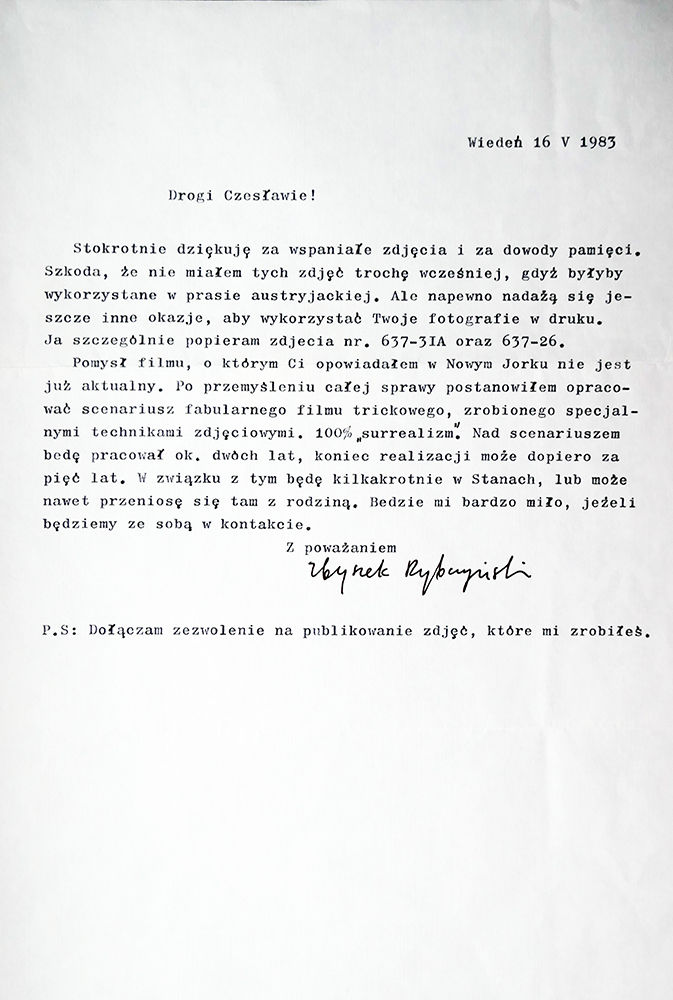
Zdjęcia z Oscarem zrobiłem Zbigniewowi kilka dni po ceremonii. To była jego pierwsza sesja zdjęciowa po otrzymaniu nagrody. Jeszcze było widać ślady po bójce – Zbigniew starannie przykrywał opuchnięte oko włosami. I to zadziorne zbuntowane spojrzenie. Nadal był zbulwersowany tym, że nie pozwolono mu powiedzieć tych słów o Solidarności. Całe to wydarzenie trochę można podsumować słowami – polska, ułańska fantazja na rozdaniu amerykańskich nagród filmowych.
Oscar dał Rybczyńskiemu prestiż i możliwość życia w USA. Do kraju wrócić nie mógł, ponieważ po wywiadzie udzielonym Wolnej Europie, w którym potępił system komunistyczny, został oskarżony o zdradę Polskiej Rzeczypospolitej Ludowej i skazany na karę więzienia. W Austrii otrzymał azyl polityczny.
Kilkanaście lat mieszkał w Nowym Jorku, gdzie kręcił kolejne, nagradzane na świecie krótkie metraże i teledyski (współpracował m.in. z Mickiem Jaggerem, Yoko Ono, Lou Reedem, Rush itd.). To właśnie on jest twórcą słynnego clipu do „Imagine” Johna Lennona. Od roku 1972 jako operator, scenarzysta, reżyser, kompozytor obrazu, Rybczyński zrealizował kilkadziesiąt filmów.
Popularność przyniosły mu wideoklipy realizowane od 1984 r. m.in. dla Chuck Mangione, Pet Shop Boys, Lou Reeda, a także do anglojęzycznej wersji „Mniej niż zero” Lady Pank (1985), „Let’s work” Micka Jaggera (1987) i „Imagine” Johna Lennona (1986, m.in. Srebrny Lew za najlepszy teledysk na MIDEM w Cannes 1987). W roku 1987 otworzył pod Nowym Jorkiem własne studio (Zbig Vision Studio), w którym oprócz wideoklipów i filmów reklamowych powstały kolejne artystyczne obrazy m.in. „Schody” (1987, Premio Internazionale Leonardo za wkład do sztuki wideo w Mediolanie, 1989) oraz zrealizowane w systemie HD: „Orkiestra” (1990, m.in. Grand Prix na Festiwalu A.V.A. w Tokio 1991),
W latach 1994 – 2001 mieszkał w Niemczech, współtworząc międzynarodowy eksperymentalny ośrodek filmowy w Berlinie (CBF). Był wykładowcą uczelni w Kolonii, Nowym Jorku i Tokio. W 2001 r. wrócił do USA.

W latach 2009-2013 był dyrektorem artystycznym Centrum Technologii Audiowizualnych CeTA we Wrocławiu, po konflikcie z dyrekcją w CeTA i ministrem kultury Bogdanem Zdrojewskim, gdzie znakomicie zapowiadający się projekt, skończył się w sądzie. W 2015 roku Rybczyński ponownie wyjechał do USA.
Kiedy w 1993 r. zapytałem Rybczyńskiego – dokonałeś w Stanach wielu rzeczy. Czy uważasz swoje związki z Ameryką za trwałe?
–Ameryka stała się moim domem. Nabieram kompleksu amerykańskiego. Kiedy gdzieś wyjeżdżam, myślę: o, u nas w Ameryce takich rzeczy nie ma, a tu są. Zaczynam bronić Ameryki. Cztery lata żyłem w Austrii, ale nigdy bym nie powiedział, że stałem się austriackim patriotą. A tu, po iluś latach, mogę to stwiedzić, jakkolwiek brzmi to dziwnie dla mnie samego.
Zaczęłem lubić Amerykę, łącznie z jej anomaliami. Czasem zadziwia mnie głupota, czy dziecinada tego kraju, ale to właśnie tworzy ciekawą sytuację „kulturową” – łatwo w tej rzeczywistości znaleźć dla siebie cel. Gdyby wszystko było wspaniałe, byłoby gorzej. Czuję się jak w Polsce. Problemy są zupełnie takie same. A równocześnie mam świadomość dostępu do najwyższej technologii. Z jednej strony nie mam więc poczucia, że jestem poza Polską. Z drugiej strony – wiem, że nigdzie indziej poza Ameryką nie mógłbym zrezalizować tego, co zamierzam.
PORTRAIT with HISTORY Zbigniew Rybczyński

“…Film was invented to record the world. But it was discovered that when more frames are recorded and then played back at normal speed, we see the world in slow motion. The camera, which was intended merely to reproduce reality, began to see far more than we do…” – Zbigniew Rybczyński, “The Traveler to the Land of Impossibility” (2000).
Zbigniew Rybczyński was born on January 27, 1949, in Łódź. He graduated from an art high school in Warsaw’s Łazienki Park. Before beginning his studies in cinematography at the Film School in Łódź (PWSFTviT), he worked for a year, in 1968, at the Miniature Film Studio in Warsaw. From the beginning of the 1970s, he worked as a cinematographer with, among others, Andrzej Barański, Piotr Andrejew, and Grzegorz Królikiewicz, but after graduating he devoted himself primarily to animation.
At the Se-Ma-For Studio of Small Film Forms in Łódź, he created several original works, including Plamuz (1973, First Prize in the music-film category at the Jazz Film Saloon in Wrocław, 1985), Soup (1974, including the Golden Badge at the Chicago International Film Festival, 1978), The New Book (1975, including the Grand Prize at the International Short Film Festival in Oberhausen), Locomotive (1976, “Bronze Goats” at the Children’s Film Festival in Poznań, 1977), and Holiday (1976, Audience Award at the “Zygzakiem” Short Film Review organized by the DKF film club in Warsaw, 1977).
In 1980, Tango was created—the most important work in the artist’s career. Its innovation in both form and narrative is perfectly captured by Ryszard Ciarka’s words: “the memory of a room after its occupants have left.” Tango was showered with awards in 1981, including the Grand Prix and Audience Award at the Annecy International Animated Film Festival, the Special Jury Prize at the Huesca International Short Film Festival, the FIPRESCI Award, and the FICC Film Clubs Award at the Oberhausen International Short Film Festival.

The film Tango is an eight-minute, wordless story about human relationships and interdependencies. Twenty-five people gradually enter a single room, creating a sum of mathematical calculations and an extraordinary visual vision. The film gives the impression of having been created by a computer, yet it was entirely the work of the artist’s hands. The individual sequences were filmed frame by frame, then cut out and superimposed. The film was showered with awards throughout Europe and eventually crossed the Atlantic.

On April 11, 1983, during the 55th Academy Awards ceremony in Los Angeles, among such stars as Meryl Streep and Ben Kingsley, a name was announced: Rybczyński.
As we know, the Academy Awards ceremony, popularly known as the Oscars and broadcast around the world from the Kodak Theatre, is one of the biggest shows on earth. Everything has to be planned down to the smallest detail. There is no room for improvisation.

I remember that once Jerzy Kosiński was supposed to present an award in one of the categories. Two weeks before the big night, he showed up for rehearsal. He walked onto the stage and read his lines from the teleprompter. A moment later, the event’s director came rushing in, visibly agitated.
“Sir, what language did you just speak?”
“English,” Kosiński replied, instinctively astonished.
“But completely unintelligibly,” the increasingly irritated director said.
“But I’ve appeared on television many times,” Jurek protested.
“No, sir, this is completely incomprehensible. These are the Oscars. Either you read it so that the whole world can understand you, or we have a problem.”

And Jurek, whether he wanted to or not, had to practice. Unfortunately, there was no leniency there. “These are the Oscars.” This was the Hollywood Dream. You had to comply. Every second on television was priceless—because the whole world was watching. Stars on the threshold of their careers would have done anything for a few seconds of airtime during the Academy Awards.

Every person nominated for an Oscar prepares in advance for the ceremony, in case they become a winner. The broadcast is transmitted with a delay of several seconds in case of unforeseen problems. This makes it possible to replace the image from one camera with the image from another.
Zbigniew Rybczyński, nominated in 1983 for his brilliant animated short Tango, was likewise instructed how to behave in case he won. He was told what everyone was told:
“Man, you’ve got this many seconds. You leave the stage when this person and that person give you the signal. If you don’t, there’ll be a problem.”
Zbigniew nevertheless managed to mention Lech Wałęsa and Solidarity.
But that was not the end of the story. When the nervous Zbigniew left the Kodak Theatre to smoke a cigarette, he forgot his invitation. He also left his Oscar statuette behind. After finishing his cigarette, he tried to go back inside. Several large security guards blocked his way.
It is difficult to blame them, after all. A man without a pass or invitation was attempting to enter what was probably, at that moment, the most heavily guarded building in the world. He was speaking in a language they could not understand and shouting, “Oscar, Oscar!” and “I have Oscar, I speak German and Polish.”
The result was that he was thrown to the ground and handcuffed. He resisted by kicking, and the Oscar winner ended up in jail. He probably would have remained there for quite some time until the matter was cleared up if it had not been for Yola Czaderska-Hayek, a promoter of Polish culture in the United States.

At the Belvedere estate belonging to Yola and her husband—and once owned by Rudolph Valentino—a great many people from Poland stayed on their way toward American success. And Yola never refused them her hospitality.
It was Yola who accompanied Zbigniew to the ceremony. When he did not return from his cigarette for a long time, she began to worry. It turned out that Rybczyński had ended up in jail, where he spent the night. He was released after his uncle, Jan Rybczyński, paid a $1,000 bail bond. Yola then made the story public. Let’s not hide the fact that this proved extremely beneficial to Zbigniew. Yola knew exactly what she was doing.
Who, apart from Poles, would have paid much attention to the winner in such an unpopular category? That evening, the Oscars for leading roles went to the extraordinary Meryl Streep for Sophie’s Choice and Ben Kingsley for his brilliant performance in Gandhi. The press wrote mainly about them. And perhaps about E.T. as well. But thanks to the unusual ending of his evening—not at the banquet, but at a police station—Rybczyński also became a subject of press coverage.
The situation was, of course, extremely embarrassing. Zbigniew was immediately released from custody and apologized to, but, truth be told, he had not ended up there without reason.
Naturally, he had not received the award without reason either. Tango is phenomenal. Moreover, it was ahead of its time. What was later accomplished with computer technology—layering multiple images on top of one another—Zbigniew achieved using an analog technique.
The message of Tango was also brilliant in its simplicity. We fail to realize that the place where we are is also a place on the map of hundreds of other people. The idea, and the form in which Zbigniew presented it, hit the mark perfectly.
The Oscar, as it has done for all its recipients, opened many doors for Zbigniew. He went on to create outstanding films, already using computer technology, including The Orchestra, for which he received numerous awards, among them an Emmy. He also became a highly regarded music-video director, working with international stars including Mick Jagger, Yoko Ono, Simple Minds, and the Pet Shop Boys.

I photographed Zbigniew with his Oscar a few days after the ceremony. It was his first photo session after receiving the award. You could still see traces of the fight—Zbigniew carefully covered his swollen eye with his hair. And there was that defiant, rebellious look in his eyes. He was still outraged that he had not been allowed to say those words about Solidarity.
The entire episode could perhaps be summed up as a distinctly Polish, cavalryman’s flair at the American Academy Awards.

The Oscar gave Rybczyński prestige and the opportunity to live in the United States. He could not return to Poland because, following an interview he gave to Radio Free Europe in which he condemned the communist system, he was accused of treason against the Polish People’s Republic and sentenced to prison. He was granted political asylum in Austria.
He lived in New York for many years, where he made further internationally acclaimed short films and music videos, working, among others, with Mick Jagger, Yoko Ono, Lou Reed, and Rush. He was also the creator of the famous music video for John Lennon’s Imagine. Since 1972, working as a cinematographer, screenwriter, director, and visual-image composer, Rybczyński created several dozen films.

He gained widespread popularity through music videos beginning in 1984, including those for Chuck Mangione, the Pet Shop Boys, and Lou Reed, as well as the English-language version of Mniej niż zero (Less Than Zero) by Lady Pank (1985), Let’s Work by Mick Jagger (1987), and John Lennon’s Imagine (1986), which received, among other distinctions, the Silver Lion for Best Music Video at MIDEM in Cannes in 1987.
In 1987, he opened his own studio near New York, Zbig Vision Studio. In addition to music videos and commercials, he created further artistic works there, including Steps (1987, Premio Internazionale Leonardo for contribution to video art, Milan, 1989) and works produced in HD, including The Orchestra (1990, among other honors, Grand Prix at the A.V.A. Festival in Tokyo, 1991).
From 1994 to 2001, he lived in Germany, helping to establish an international experimental film center in Berlin (CBF). He taught at universities in Cologne, New York, and Tokyo. In 2001, he returned to the United States.

From 2009 to 2013, he was artistic director of the Center for Audiovisual Technologies (CeTA) in Wrocław. Following a conflict with the management of CeTA and Minister of Culture Bogdan Zdrojewski, an ambitious and promising project ended up in court. In 2015, Rybczyński left for the United States once again.

When I asked Rybczyński in 1993, “You have accomplished many things in the United States. Do you consider your relationship with America to be permanent?” he replied:
“America has become my home. I’m developing an American complex. When I travel somewhere, I think: Oh, back home in America we don’t have things like this, but here they do. I’m beginning to defend America. I lived in Austria for four years, but I would never have said that I had become an Austrian patriot. Here, after so many years, I can say it, however strange that may sound even to me.
I have grown to like America, including its anomalies. Sometimes I am astonished by the stupidity or childishness of this country, but that is precisely what creates an interesting ‘cultural’ situation—it is easy to find a goal for yourself in this reality. If everything were wonderful, it would be worse. I feel as if I were in Poland. The problems are exactly the same. At the same time, I am aware that I have access to the most advanced technology. On the one hand, therefore, I do not feel that I am outside Poland. On the other hand, I know that nowhere but America could I accomplish what I intend to do.”


Komentarze