PORTRET z HISTORIĄ NEW HOPE
- Czesław Czapliński

- 12 minut temu
- 7 minut(y) czytania

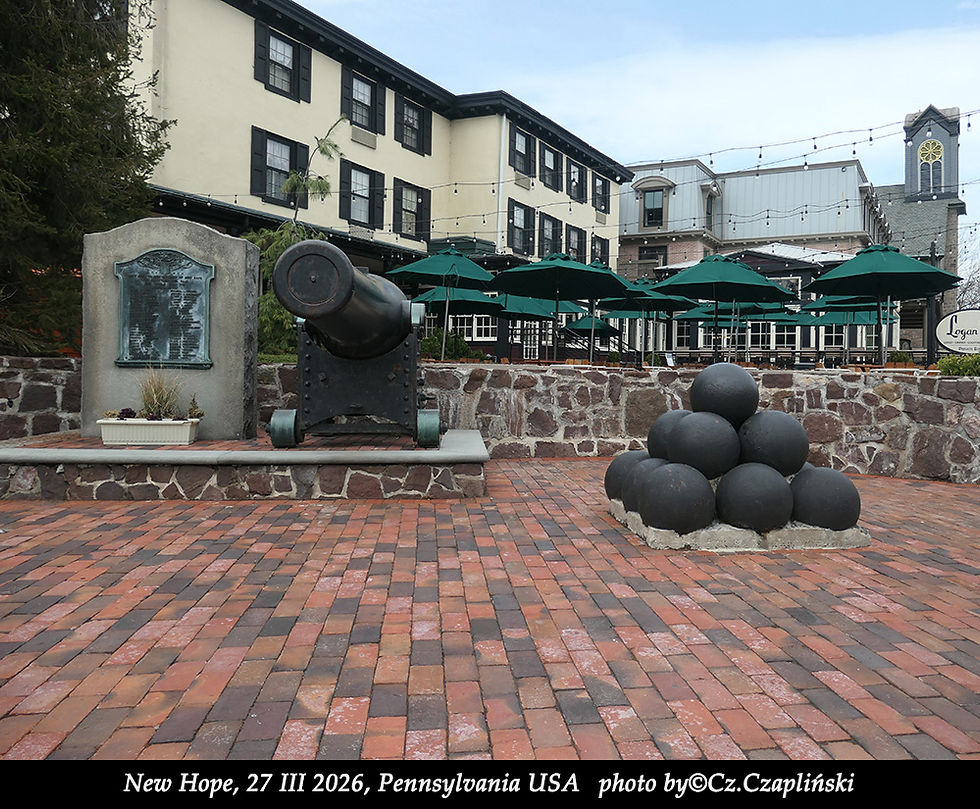
“…NEW HOPE to w bezpośrdnim tłumaczeniu NOWA NADZIEJA, tak nazywa się miasto, które odwiedziłem 27 marca 2026 r., oddalone jest od Nowego Jorku o 70 mil. Muszę powiedzieć, że robi wielkie wrażenie, proszę zobaczyć na zdjęciach…” – Czesław Czapliński.
New Hope to gmina (borough) w hrabstwie Bucks County, w stanie Pennsylvania, w Stany Zjednoczone. Według spisu z 2020 roku liczyła 2 612 mieszkańców. New Hope leży około 30 mil (48 km) na północ od Filadelfia, na zachodnim brzegu rzeki Delaware River, przy jej ujściu do potoku Aquetong Creek. New Hope oraz sąsiednie gminy Solebury i Upper Makefield należą do obszaru metropolitalnego Filadelfii. Dwupasmowy most New Hope–Lambertville umożliwia ruch samochodowy i pieszy przez Delaware do Lambertville po wschodniej stronie rzeki. Główną gałęzią gospodarki New Hope jest turystyka.

New Hope leży przy dawnej trasie Old York Road, niegdyś głównej drodze między Filadelfią a Nowy Jork. Uważano ją za punkt mniej więcej w połowie drogi, gdzie podróżni zatrzymywali się na nocleg, a następnego dnia byli przewożeni promem przez rzekę Delaware. Odcinek drogi krajowej U.S. Route 202, biegnący na północ od New Hope, nadal nosi nazwę York Road, a pierwotna trasa to obecnie Bridge Street (PA 179).
Początkowo miejscowość nazywała się Wells' Ferry, a później Coryell's Ferry — od właścicieli przeprawy promowej. Obecna nazwa pojawiła się po pożarze w 1790 roku, który zniszczył kilka młynów należących do Benjamin Parry. Odbudował je i nazwał New Hope Mills, skąd wywodzi się dzisiejsza nazwa miasta.

W noc poprzedzającą przeprawę George Washington przez rzekę Delaware, Washington zatrzymał się w New Hope, a następnie zniszczył prom, aby armia brytyjska nie mogła go ścigać. Po bitwach pod Trenton i Princeton, gdy wojska brytyjskie przeczesywały okolicę w poszukiwaniu armii kontynentalnej, nie otrzymały odpowiedzi na wezwanie promu. Uznając, że miasto sympatyzuje z armią kontynentalną, ostrzelały je. Niektóre starsze budynki do dziś twierdzą, że w ich konstrukcjach dachowych tkwią niewybuchy z tamtego okresu.
Linia kolejowa North Pennsylvania Railroad ukończyła swoją odnogę do New Hope w 1891 roku, później przejętą przez Reading Railroad. Ruch pasażerski do terminalu Reading w Filadelfii oraz inne połączenia zakończono w 1952 roku w Hatboro, co oznaczało także koniec trakcji elektrycznej do New Hope.

W 1983 roku prezenterka NBC Jessica Savitch i jej partner utonęli, gdy ich samochód wpadł do kanału Delaware. Wcześniej jedli kolację w restauracji Odette's podczas deszczowego wieczoru, gdy widoczność była ograniczona i przeoczyli znaki ostrzegawcze.
W 2004 i 2006 roku New Hope zostało zalane wskutek wylania rzeki Delaware. W obu przypadkach centrum miasta wznowiło działalność po kilku dniach. W porównaniu z wielką powodzią z 1955 roku, późniejsze powodzie nie spowodowały poważnych zniszczeń ani ofiar śmiertelnych.
Według U.S. Census Bureau, powierzchnia gminy wynosi 1,4 mili kwadratowej (3,6 km²), z czego 1,3 mili kwadratowej (3,4 km²) stanowi ląd, a 0,2 mili kwadratowej (0,52 km²) (11,19%) to woda — głównie rzeka Delaware.

Miejscowość leży u zbiegu rzeki Delaware i potoku Aquetong (Ingham) Creek, który bierze początek w sąsiedniej gminie Solebury w źródłach Ingham Springs — najwydajniejszym źródle w południowo-wschodniej Pensylwanii. Nazwa Aquetong pochodzi z języka Lenape i oznacza „źródło w krzakach”, natomiast Ingham odnosi się do Samuel D. Ingham. W pobliżu ujścia w New Hope potok tworzy malowniczy staw młyński i wodospad przy Bucks County Playhouse, dawnym młynie.
Dawne nazwy miejscowe Hood i Hufnagel są obecnie częścią borough.
New Hope użyczyło nazwy kolonii artystycznej New Hope, założonej przez Edward Willis Redfield i William Langson Lathrop, która stworzyła znaczące dzieła regionalne. Do jej członków należeli m.in. George Sotter, Daniel Garber i Fern Coppedge.

W latach 50. XX wieku New Hope stało się popularnym ośrodkiem wypoczynkowym dla społeczności LGBT i do dziś posiada liczną oraz aktywną społeczność. W cieplejszych miesiącach przyciąga także motocyklistów.
Firma Union Camp Corporation prowadziła w New Hope zakład produkcji toreb do połowy lat 90., zatrudniający około 100 osób. Obecnie teren ten, znany jako Union Square, został przekształcony w kompleks sklepów i usług związanych z turystyką.
W latach 2010–2014 lokalne izby handlowe organizowały letnie pokazy fajerwerków w każdy piątek, aby zwiększyć ruch turystyczny. Choć restauracje i bary korzystały na tym, mieszkańcy krytykowali wydarzenia za hałas i problemy z parkowaniem. W 2014 roku zrezygnowano z pokazów, wskazując m.in. na wzrost kradzieży i ilości śmieci.
Do miejsc wpisanych do Krajowego Rejestru Miejsc Historycznych należą m.in. Cintra, Joshua Ely House, New Hope Village District, Rhoads Homestead oraz Springdale Historic District.

Znane osoby związane z New Hope:
Robert Beck – artysta
Rebecca Blasband – osobowość telewizyjna i wokalistka
Gregg Cagno – muzyk folkowy
Steve Garvey – basista punkowy (Buzzcocks)
Patricia Highsmith – pisarka
George Nakashima – projektant mebli i architekt
Bryan Scott – zawodnik NFL
Ted Tally – scenarzysta
Artyści impresjoniści związani z regionem:
Rae Sloan Bredin
Morgan Colt
L. Birge Harrison
Walter Elmer Schofield
Robert Spencer
PORTRAIT with HISTORY New Hope

“…NEW HOPE literally translates to ‘New Hope.’ That is the name of the town I visited on March 27, 2026. It is located 70 miles from New York. I must say, it makes a great impression—please take a look at the photos…” – Czesław Czapliński.
New Hope is a borough in Bucks County, Pennsylvania, United States. The population was 2,612 at the 2020 census. New Hope is located approximately 30 mi (48 km) north of Philadelphia, and lies on the west bank of the Delaware River at its confluence with Aquetong Creek. New Hope and neighboring Solebury and Upper Makefield townships are part of the Philadelphia metropolitan area. The two-lane New Hope–Lambertville Bridge carries automobile and foot traffic across the Delaware to Lambertville, New Jersey, on the east bank. New Hope's primary industry is tourism.

New Hope is located along the route of the Old York Road, the onetime main highway between Philadelphia and New York City. It was generally regarded as the halfway point, where travelers would stay overnight and be ferried across the Delaware River the next morning. The section of U.S. Route 202 that passes just north of New Hope is still named York Road, and the original route is now Bridge Street (PA 179).
New Hope was first called Wells' Ferry and later Coryell's Ferry, after the owners of the ferry business. The current name came into use following a fire in 1790 that destroyed several mills owned by Benjamin Parry. He rebuilt them and named them New Hope Mills, from which the town derives its current name.

The night prior to George Washington's crossing of the Delaware River, Washington lodged in New Hope, and then destroyed the ferry so the British Army could not follow him. Following the Battle of Trenton and Battle of Princeton, when British troops were sweeping the area, seeking Continental Army troops, there was no response when they rang for the ferry. The British assumed the town was sympathetic to the Continental Army and shelled the town. Several of the older structures in the town still claim to have unexploded British ordnance lodged in their roofbeams.
The North Pennsylvania Railroad finished construction of their New Hope Branch in 1891, later being taken over by the Reading Railroad. Passenger service to Philadelphia's Reading Terminal as well as all other passenger activity was terminated in 1952 from Hatboro, also the end for electrified track, and New Hope.

In 1983, NBC network anchorwoman Jessica Savitch and her boyfriend drowned after their car overturned into the Delaware Canal. The canal passes by Odette's Restaurant, where the couple had dined on a rainy evening when visibility was poor and two warning signs were missed.

In 2004 and 2006, New Hope was flooded when the Delaware River overflowed. On both occasions, the downtown businesses reopened within several days. Compared to the Great Flood of 1955, the 2004 and 2006 floods did not cause severe damage or fatalities.
According to the U.S. Census Bureau, the borough has a total area of 1.4 square miles (3.6 km2), of which 1.3 square miles (3.4 km2) is land and 0.2 square miles (0.52 km2) (11.19%) is water. Much of that water is the Delaware River.
The borough is located at the confluence of the Delaware River and Aquetong (Ingham) Creek, which begins its two-mile course in neighboring Solebury Township at Ingham Springs, the most productive spring in Southeastern Pennsylvania. The name Aquetong comes from a Lenape word meaning "spring in the bushes,"[6] while Ingham refers to Samuel D. Ingham, an industrialist, congressman, and advocate of the canal that would run through the town. Near its end in New Hope, the creek forms a scenic millpond and waterfall near the Bucks County Playhouse, a former mill.

The former place names Hood and Hufnagel are now part of the borough.
New Hope lent its name to the New Hope art colony, founded by Edward Willis Redfield and William Langson Lathrop, that produced noted regional work. Members or associates of the colony included George Sotter, Daniel Garber and Fern Coppedge. The colony was centered north of New Hope Borough in Phillips Mill, Solebury Township.

New Hope became a popular gay resort in the 1950s, and continues to have an active and large gay community.[22] New Hope also attracts motorcyclists on weekends in the warmer months.
Union Camp Corporation had a bag production facility in New Hope until the mid 1990s, which employed about 100 and was located uphill from the railroad. The former factory complex, now known as Union Square, has been re-purposed into tourism-related shops and businesses.

In 2010, the New Hope and Lambertville area Chambers of Commerce conducted a fireworks show every Friday night during the summer to increase tourism and merchant revenue. Bars and restaurants benefited from the fireworks show, but residents criticized the weekly event, claiming it was disruptive and reduced parking. In 2014, the New Hope Chamber of Commerce canceled the firework show, citing a rise in shoplifting, garbage, and an overall decline in store traffic and Friday night revenues.
Historic sites Cintra, Joshua Ely House, New Hope Village District, Rhoads Homestead, and Springdale Historic District are listed on the National Register of Historic Places.

Notable people:
• Robert Beck, artist
• Rebecca Blasband, television personality and singer-songwriter
• Gregg Cagno, folk singer-songwriter
• Steve Garvey, punk rock bassist for the Buzzcocks
• Patricia Highsmith, novelist and short story writer
• Thomas Holmes, former CEO of Ingersoll Rand
• Marijane Meaker, writer
• Thom Michael Mulligan, actor and executive director of the New Hope Film Festival
• Odette Myrtil, actress, singer, violinist
• George Nakashima, woodworker, architect, and furniture maker who was one of the leading innovators of 20th century furniture design and a father of the American craft movement
• Steve Neumann, professional soccer player
• Joseph Pickett, folk painter
• Antonin Raymond, architect and interior designer
• Michele Sainte, club and rave DJ
• Bryan Scott, NFL player
• Ted Tally, screenwriter and playwright
• Dean Ween (Michael Melchiondo) and Gene Ween (Aaron Freeman), founding members of the band Ween
• Chuck Wendig, author and screenwriter
• Amber Wisner, professional women's soccer player, Washington Spirit
• Winter Ave Zoli, actress

Impressionist artists:
• Rae Sloan Bredin, landscape painter
• Morgan Colt, architect and landscape painter
• Fern Coppedge, landscape painter
• L. Birge Harrison, landscape painter, instructor at the Art Students League of New York
• John Fulton Folinsbee, landscape and marine painter
• Harry Leith-Ross, Scottish-American landscape painter
• Mary Elizabeth Price, landscape painter
• Charles Rosen, landscape painter
• Walter Elmer Schofield, landscape and marine painter
• Robert Spencer, landscape painter


Komentarze