PORTRET z HISTORIĄ John Houseman
- Czesław Czapliński

- 7 sty
- 5 minut(y) czytania

John Houseman, właśc. Jacques Haussmann (ur. 22 września 1902 w Bukareszcie, zm. 31 października 1988 w Malibu) – amerykański aktor charakterystyczny, producent filmowy i scenarzysta. Laureat Oscara za najlepszą rolę drugoplanową jako profesor Charles W. Kingsfield w komediodramacie Jamesa Bridgesa W pogoni za papierkiem (1973).
Urodził się w Bukareszcie w Królestwie Rumunii jako syn May (z domu Davies), brytyjskiej guwernantki pochodzenia walijskiego i irlandzkiego, oraz Georgesa Haussmanna, żydowskiego przedsiębiorcy zbożowego urodzonego w Alzacji. Kształcił się w Clifton College w Bristolu, a następnie pracował w handlu zbożem w Londynie. W 1925 wyemigrował do Stanów Zjednoczonych, gdzie przyjął pseudonim sceniczny John Houseman. Po krachu giełdowym w 1929 porzucił działalność finansową i zwrócił się ku teatrowi. Obywatelstwo USA uzyskał w 1943.

Na Broadwayu był współautorem komedii Trzy i jeden (1933) oraz I bądź moją miłością (1934). W 1934 współpracował z kompozytorem Virgilem Thomsonem i Gertrude Stein przy operze Czterech świętych w trzech aktach, a także reżyserował m.in. Panią z morza i Kuźnię doliny. W tym samym roku był producentem sztuki Panika Archibalda MacLeisha.
W 1937 wraz z Orsonem Wellesem założył Mercury Theatre, produkując i reżyserując spektakle sceniczne oraz audycje radiowe. Wcześniej, w ramach Federal Theatre Project, powierzył Wellesowi reżyserię słynnej inscenizacji Makbeta (1936), znanej jako „Voodoo Makbet”, osadzonej na haitańskim dworze króla Henriego Christophe’a. Houseman wykładał również w Vassar College, a w latach 1968–1976 był dyrektorem wydziału teatralnego Juilliard School. Wśród jego studentów znaleźli się m.in. Kevin Kline, Patti LuPone, William Hurt, Christopher Reeve, Mandy Patinkin i Robin Williams.

Jako producent filmowy pracował m.in. przy Liście od nieznajomej (1948), Pięknym i złym (1952) oraz Juliuszu Cezarze (1953), za którego otrzymał nominację do Oscara dla najlepszego filmu. Wyprodukował także nigdy nieukończony debiut filmowy Orsona Wellesa Too Much Johnson (1938).
Szeroką popularność przyniosły mu role aktorskie w późniejszym okresie kariery. Otrzymał Oscara, Złoty Glob i nagrodę National Board of Review za rolę profesora Kingsfielda w filmie W pogoni za papierkiem (1973). Za telewizyjną wersję The Paper Chase był dwukrotnie nominowany do Złotego Globu. Wystąpił również m.in. w filmach Rollerball (1975), Trzy dni Kondora (1975), Mgła (1980) oraz Naga broń (1988). W miniserialu Wichry wojny (1983) stworzył cenioną kreację Aarona Jastrowa, za którą otrzymał kolejną nominację do Złotego Globu.

5 października 1929 poślubił aktorkę Zitę Johann (rozwód w 1933). Od 1952 był żonaty z Joan Courtney, z którą miał dwóch synów: Johna i Charlesa.
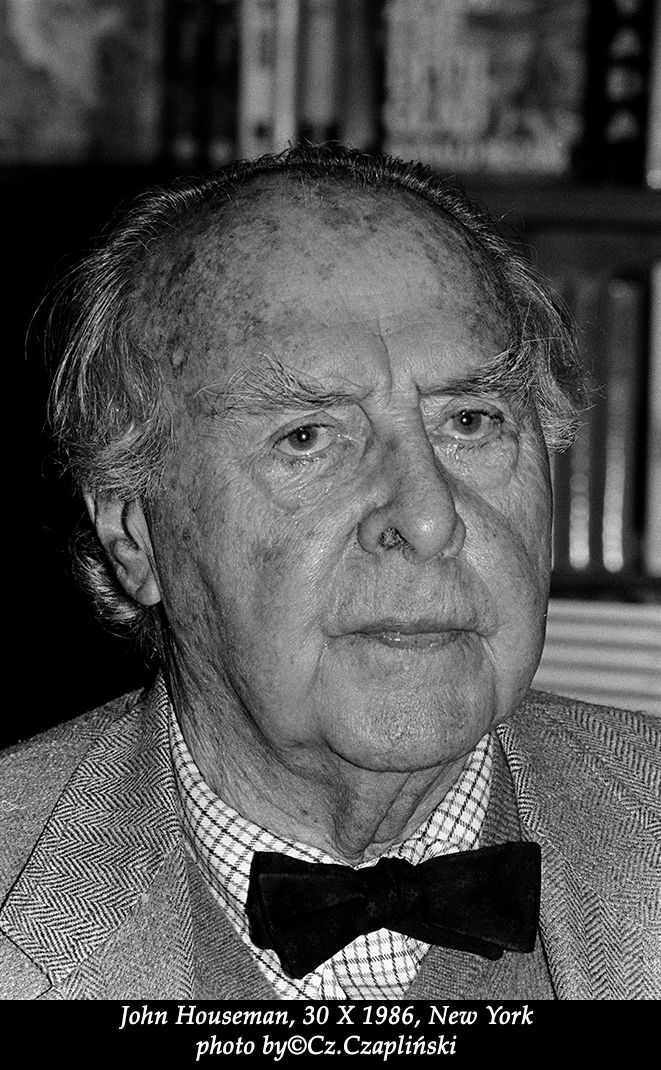
„Johna Housemana spotkałem 30 października 1986 roku w Nowym Jorku. Dwa lata później zmarł. Cieszę się, że udało mi się zrobić mu zdjęcie i z nim porozmawiać.”— Czesław Czapliński.

Zmarł 31 października 1988 w swoim domu w Malibu na raka kręgosłupa, w wieku 86 lat. Został skremowany, a jego prochy rozsypano w oceanie.
Postać Housemana była wielokrotnie portretowana w filmach i słuchowiskach – grali go m.in. Cary Elwes (Cradle Will Rock, 1999), Eddie Marsan (Ja i Orson Welles, 2008) oraz Sam Troughton (Mank, 2020).
PORTRAIT with HISTORY John Houseman

John Houseman – Jacques Haussmann (born September 22, 1902, in Bucharest; died October 31, 1988, in Malibu) – an American character actor, film producer, and screenwriter. He was the recipient of the Academy Award for Best Supporting Actor for his role as Professor Charles W. Kingsfield in James Bridges’s comedy-drama The Paper Chase (1973).
He was born in Bucharest in the Kingdom of Romania as the son of May (née Davies), a governess, and Georges Haussmann, who ran a grain business. His mother was British, from a Christian family of Welsh and Irish descent. His father was a Jew born in Alsace. He was educated in England at Clifton College in Bristol and worked in the grain trade in London before emigrating to the United States in 1925, where he adopted the stage name John Houseman. Houseman worked as a speculator on international grain markets, turning to the theatre only after the stock market crash of 1929. He became a citizen of the United States in 1943.

On Broadway, he co-wrote the comedy Three and One (1933) with Brian Donlevy and And Be My Love (1934). Composer Virgil Thomson recruited him to direct Four Saints in Three Acts (1934), a collaboration between Thomson and Gertrude Stein. He later directed The Lady from the Sea (1934) and Valley Forge (1934). In 1934, he was the producer of a production based on Archibald MacLeish’s play Panic.

In 1937, together with Orson Welles, he founded the Mercury Theatre, where he produced and directed radio programs and stage presentations. At the same time, he was a teacher at Vassar College. In 1936, Houseman hired Welles and appointed him director of Macbeth for the Federal Theatre Project—a controversial production that became known as the “Voodoo Macbeth,” as it was set at the Haitian court of King Henri Christophe. In 1954, he began working on off-Broadway productions, directing William Shakespeare’s Coriolanus.
He produced Orson Welles’s never-completed first film, the comedy Too Much Johnson (1938), starring Joseph Cotten. As producer of Joseph L. Mankiewicz’s historical drama Julius Caesar (1953), he received an Academy Award nomination for Best Picture.
From 1968 to 1976, he served as director of the drama division at the Juilliard School. Among its graduates during his tenure were Kevin Kline, Patti LuPone, William Hurt, Christopher Reeve, Mandy Patinkin, and Robin Williams.

For his portrayal of the conscientious law professor Charles W. Kingsfield in the CBS series The Paper Chase (1978–1986), he was nominated for the Golden Globe Award for Best Actor in a Television Drama Series in 1979 and 1980. His performance as Aaron Jastrow in the miniseries The Winds of War (1983) earned him a Golden Globe nomination for Best Supporting Actor in a Series, Miniseries, or Television Film.
On October 5, 1929, he married Zita Johann; they divorced on September 13, 1933. On November 11, 1952, he married Joan Courtney, with whom he had two sons, John and Charles.

“…I met John Houseman on October 30, 1986, in New York. Interestingly, two years after our meeting he died. I am glad that I managed to photograph him and talk with him…” — Czesław Czapliński.
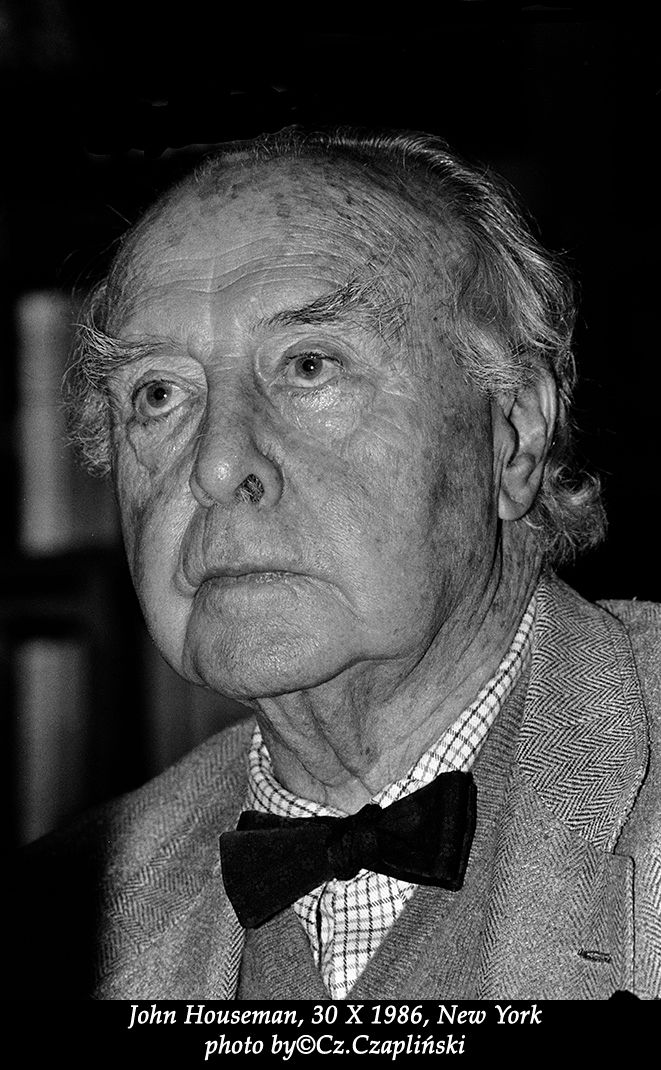
He died on October 31, 1988, at his home in Malibu, California, from spinal cancer at the age of 86. He was cremated, and his ashes were scattered at sea.
In Tim Robbins’s comedy-drama Cradle Will Rock (1999), Houseman was portrayed by Cary Elwes. Actor Eddie Marsan played Houseman in Richard Linklater’s drama Me and Orson Welles (2008). Houseman was also portrayed by actor Jonathan Rigby in the audio drama Doctor Who – Invaders from Mars (2002), which revolves around the broadcast of The War of the Worlds. Actor Sam Troughton played Houseman in David Fincher’s biographical drama Mank (2020).
Filmography
Acting roles:1964 – Seven Days in May as Vice Admiral Farley C. Barnswell1973 – The Paper Chase as Charles W. Kingsfield Jr.1975 – Rollerball as Bartholomew1975 – Three Days of the Condor as Mr. Wabash1980 – The Fog as Mr. Machen1988 – A Christmas Show – as himself1988 – Another Woman as Mr. Post1988 – The Naked Gun: From the Files of Police Squad! as the driving instructor
Television series:1976 – The Six Million Dollar Man as Dr. Lee Franklin1982 – Mork & Mindy as Milt1982 – Marco Polo as the Patriarch of Aquileia1983 – The Winds of War as Aaron Jastrow

Producer:1948 – Letter from an Unknown Woman1952 – The Bad and the Beautiful1953 – Julius Caesar1956 – Lust for Life1962 – Two Weeks in Another Town
Awards:1974 – Golden Globe Award for Best Supporting Actor (The Paper Chase, 1973);Academy Award for Best Supporting Actor (The Paper Chase, 1973);National Board of Review Award for Best Supporting Actor.


Komentarze