PORTRET z HISTORIĄ Joan Sutherland


Joan Sutherland (ur. 7 listopada 1926 w Sydney, zm. 10 października 2010 w Genewie) – australijska śpiewaczka operowa, sopranistka, znana jako „La Stupenda”.

Karierę rozpoczęła w rodzinnej Australii, ale przełomem był dla niej wyjazd w 1951 do Londynu, gdzie studiowała dalej śpiew i poznała przyszłego męża, pianistę i dyrygenta Richarda Bonynge. Za jego radą przestawiła swój głos na sopran koloraturowy. W tym okresie miał miejsce (m.in. dzięki działalności Marii Callas) renesans belcanta. Sutherland stała się cenioną i poszukiwaną odtwórczynią ról w operach takich jak Łucja z Lammermooru Gaetano Donizettiego czy Norma Vincenzo Belliniego. Miała w repertuarze także bardziej dramatyczne partie, takie jak Violetta w Traviacie, a w nagraniu wystąpiła nawet jako Turandot.

Ze względu na nadzwyczajne możliwości głosu nazywano ją „La Stupenda” („Zdumiewająca”), Luciano Pavarotti nazwał Dame Joan „głosem stulecia”, a Montserrat Caballé określiła jej głos jako „niebiański”, choć przez całą karierę krytycy wytykali jej złą dykcję i kiepskie aktorstwo. Na scenie towarzyszyli jej często m.in. Marilyn Horne i Luciano Pavarotti. Pozostawiła po sobie obszerną dyskografię, nagrywając niemal wyłącznie dla wytwórni Decca Records.

W 1971 roku Time opublikował artykuł porównujący Sutherland i Beverly Sills:
Jej głos, pierwotnie jasny i młodzieńczy w brzmieniu, ściemniał, gdy przekształciła się w sopran koloraturowy. W centralnym rejestrze Sutherland można dostrzec sugestię słynnego średniego rejestru Callas — barwy, która brzmi tak, jakby śpiewaczka śpiewała w szyjkę rezonującej butelki. Dziś głos Sutherland góruje niczym cud natury, jedyny w swoim rodzaju jak Niagara czy Mount Everest. Głos Sills zbudowany jest z bardziej zwyczajnego materiału; tym, co łączy ją z Callas, jest bezgraniczne oddanie w rzucaniu się w ogniste, emocjonalne frazy oraz gotowość poświęcenia piękna brzmienia dla efektu dramatycznego. Sutherland operuje wokalnym aksamitem, Sills — emocjonalnym dynamitem. Głos Sutherland jest znacznie większy, ale jego pluszowa jednobarwność pozbawia go siły przebicia w momentach dramatycznych. Wielobarwny głos Sills, choć mniejszy, lepiej się niesie i ma ostre brzmienie, które potrafi przebić się przez największą orkiestrę i chór. Czasami wręcz ociera się o piskliwość. [...] W wolnych, legatowych frazach Sills ma lepsze wyczucie rytmu i czyste wejścia, które utrzymują muzykę w ruchu; bardziej wiotki puls Sutherland i jej styl przesuwania się z dźwięku na dźwięk często zamieniają pieśń w senność. Dykcja Sills w języku angielskim, francuskim i włoskim jest znakomita; emisja Sutherland powoduje niewyraźną dykcję w każdym języku, ale umożliwia jeszcze bardziej jednolitą, nieprzerwaną urodę brzmienia, niż może zaoferować Sills.

W 1979 otrzymała tytuł szlachecki. Pod koniec lat 80. wycofała się z publicznych występów. Pożegnalna gala artystki odbyła się w Sydney Opera House, Sutherland wystąpiła w roli Małgorzaty de Valois w Hugonotach Giacomo Meyerbeera. W 1997 wydała autobiografię zatytułowaną The autobiography of Joan Sutherland: A Prima Donna's Progress.

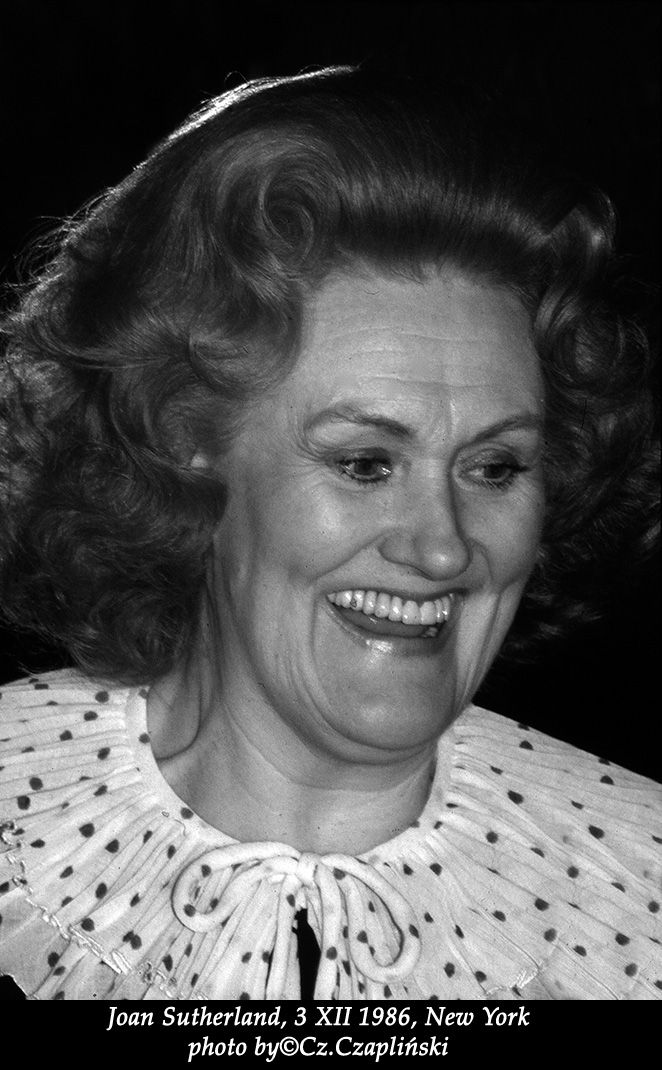
“…3 grudnia 1986 spotkałem Dane Joan Suttherland w Nowym Jorku i wówczas powstała seria unikalnych zdjęć. Muszę powiedzieć, że to zupełnie coś innego niż widzieć ja na scenie w oddali, a tu z bliska, to było w czasie, kiedy wycofała się z publicznych występów…” – Czesław Czapliński.

W 1997 roku opublikowała autobiografię A Prima Donna's Progress. Otrzymała ona mieszane recenzje pod względem wartości literackich. Library Journal stwierdził:
„…Supergwiazda opery, dama Joan Sutherland, przedstawia wyczerpującą relację ze swojej kariery scenicznej i nagraniowej trwającej ponad cztery dekady. Od jej wczesnych lat w Australii i pracy z zespołem Covent Garden w Londynie, po wymagający grafik w większości najważniejszych teatrów operowych na świecie — czytamy bez końca o tym, gdzie, kiedy i z kim śpiewała poszczególne role. Ukazana jest jako rozsądna kobieta i ciężko pracująca artystka, z dużym ego złagodzonym poczuciem humoru, które często bywa autoironiczne…”
Sutherland została pochowana na cmentarzu Clarens VD. Obok jej grobu znajduje się przyszłe miejsce spoczynku jej małżonka.
PORTRAIT with HISTORY Joan Sutherland

Joan Sutherland (born 7 November 1926 in Sydney, died 10 October 2010 in Geneva) was an Australian operatic soprano known as “La Stupenda.”
She began her career in her native Australia, but the breakthrough came with her move to London in 1951, where she continued her vocal studies and met her future husband, the pianist and conductor Richard Bonynge. On his advice, she shifted her voice to the coloratura soprano repertoire. This period coincided with a bel canto revival (due in part to the work of Maria Callas). Sutherland became a valued and sought-after interpreter of roles in operas such as Lucia di Lammermoor by Gaetano Donizetti and Norma by Vincenzo Bellini. She also sang more dramatic parts, such as Violetta in La Traviata, and even recorded the role of Turandot.

Because of her extraordinary vocal abilities, she was called “La Stupenda” (“The Amazing One”). Luciano Pavarotti described Dame Joan as “the voice of the century,” and Montserrat Caballé called her voice “heavenly,” although throughout her career critics often pointed out her poor diction and weak acting. She frequently shared the stage with artists such as Marilyn Horne and Luciano Pavarotti. She left behind an extensive discography, recording almost exclusively for Decca Records.

In 1971, Time writes an article comparing Sutherland and Beverly Sills,
Originally bright and youthful-sounding, her voice darkened as she transformed herself into a coloratura. There is a suggestion of Callas' famous middle register in Sutherland's vocal center—a tone that sounds as if the singer were singing into the neck of a resonant bottle. Today the Sutherland voice towers like a natural wonder, unique as Niagara or Mount Everest. Sills' voice is made of more ordinary stuff; what she shares with Callas is an abandon in hurling herself into fiery emotional music and a willingness to sacrifice vocal beauty for dramatic effect. Sutherland deals in vocal velvet, Sills in emotional dynamite. Sutherland's voice is much larger, but its plush monochrome robs it of carrying power in dramatic moments. Sills' multicolored voice, though smaller, projects better and has a cutting edge that can slice through the largest orchestra and chorus. Sometimes, indeed, it verges on shrillness. [...] In slow, legato music, Sills has a superior sense of rhythm and clean attack to keep things moving; Sutherland's more flaccid beat and her style of gliding from note to note often turn song into somnolence. Sills' diction in English, French and Italian is superb; Sutherland's vocal placement produces mushy diction in any language, but makes possible an even more seamless beauty of tone than is available to Sills.
She was knighted in 1979. In the late 1980s, she retired from public performances. Her farewell gala took place at the Sydney Opera House, where Sutherland appeared as Marguerite de Valois in Giacomo Meyerbeer’s Les Huguenots. In 1997 she published her autobiography entitled The Autobiography of Joan Sutherland: A Prima Donna's Progress.

“…On December 3, 1986, I met Dame Joan Sutherland in New York, and that’s when a series of unique photographs was created. I must say that it was something completely different from seeing her on stage from a distance; here, up close — it was at a time when she had withdrawn from public performances…” – Czesław Czapliński.

In 1997, she published an autobiography, A Prima Donna's Progress. It received mixed reviews for its literary merits. Library Journal stated, – Opera superstar Dame Joan Sutherland gives an exhaustive account of her performing and recording career over four decades. From her early years in Australia and with the Covent Garden company in London, to her daunting schedule at most of the major opera houses of the world, we read endlessly of where, when, and with whom she sang which roles. We're shown a sensible woman and a hard-working artist, with a healthy ego tempered by a sense of humor that is often self-deprecating.

Sutherland was buried at the Clarens VD cemetery. Next to her grave is the future resting place of her husband.


Komentarze