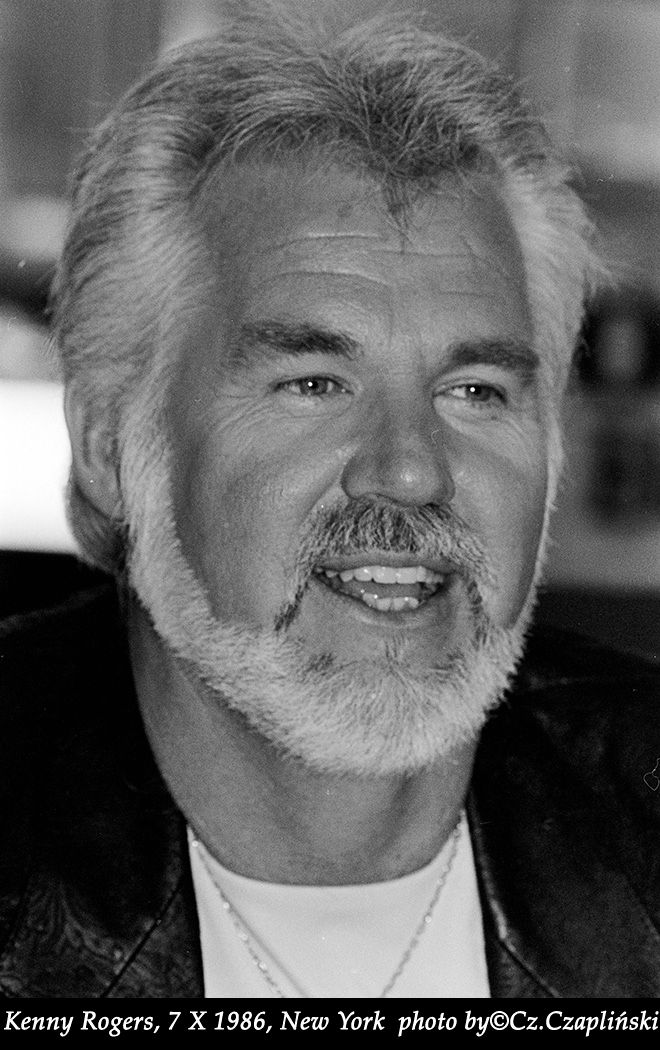
PORTRET z HISTORIĄ Kenny Rogers
- Czesław Czapliński

- 22 mar 2020
- 12 minut(y) czytania
Zaktualizowano: 11 lut

„…Cóż, nie sądzę, że wszystko, co dotykam, zmienia się w złoto, ale myślę, że czerpię z tego wielką radość, niezależnie od tego, czy odniesie sukces, czy nie…” – Kenny Rogers – pytany o popularność powiedział, że jego piosenki „mówią to, co każdy mężczyzna chce powiedzieć i co każda kobieta chce usłyszeć”.

Kenneth Ray Donald Rogers (ur. 21 sierpnia 1938 w Houston, zm. 20 marca 2020 w Sandy Springs) – amerykański aktor, piosenkarz, kompozytor, autor tekstów piosenek, a także fotograf krajobrazów. W 2013 został wprowadzony do Alei Sław Muzyki Country. Laureat trzech nagród Grammy – w 1977, 1979 i 1987. Debiutował w połowie lat 50. XX wieku. W drugiej połowie lat 60. zdobył popularność jako wykonawca i autor piosenek country. Światową sławę zdobył w połowie lat 70. lansując m.in. przebój „Lucille”. Jego najbardziej znane utwory to: „Lady”, „Ruby Don’t Take Your Love To Town”, „The Asembler”, „She Believes In Me”, „Islands In The Stream”, „We’ve Got Tonight”, „Buy Me A Rose”, „Morning Desire”, „The Vows Go Unbroken”, „Buried Treasure”, „Crazy”, „What About Me”, „Twenty Years Ago”, „Make No Mistake, She’s Mine”, „Tomb Of The Unknown Love”, „I Prefer The Moonlight”, „Love Is Strange”, „The Gambler” i „Daytime Friends”. W 1977 opublikował swoje wspomnienia zatytułowane Making It with Music. Zagrał kilka ról filmowych. W 1985 wziął udział, razem z artystami Stanów Zjednoczonych, w nagraniu piosenki „We Are the World” skomponowanej przez Michaela Jacksona i Lionela Richiego, by w ramach akcji USA for Africa zebrać fundusze na walkę z głodem w Etiopii, spowodowanym suszą w latach 1984/1985. W 2007 w Wielkiej Brytanii jego utwór „The Gambler” (nagrany w 1978) stał się nieoficjalnym hymnem angielskiej drużyny rugby podczas Pucharu świata w rugby union mężczyzn. Ostatni raz wystąpił w październiku 2017 w Nashville.

Urodził się i dorastał w Houston w Teksasie jako czwarte z ośmiorga dzieci Lucille Lois (z domu Hester; 1910–1991), asystentki pielęgniarki, i Edwarda Floyda Rogers (1904–1975), stolarza. Miał czterech braci – Lelana, Roya, Billy’ego i Randy’ego oraz trzy siostry – Geraldine, Barbarę i Sandy.Uczęszczał do Wharton Dual Language Academy. Po ukończeniu Jefferson Davis High School, w 1959 krótko studiował na Uniwersytecie Teksańskim.

W 1956, gdy był w szkole średniej, założył swój pierwszy zespół, The Scholars. Wykonał swój pierwszy solowy singiel „That Crazy Feeling” (1957), w telewizyjnym programie muzycznym American Bandstand. W 1958 został zatrudniony w małej lokalnej wytwórni Carlton Records. W 1966 dołączył do grupy folkowej The New Christy Minstrels. Rogers i jego koledzy, Mike Settle, Terry Williams i Thelma Camacho, opuścili grupę. W 1967 stworzyli własny zespół, The First Edition (później przemianowany na Kenny Rogers and the First Edition). Znalazł się w centrum uwagi i zmienił wkrótce nazwę na Kenny Rogers i The First Edition. Zespół, który grał muzykę country, pop i psychodeliczną, miał kilka hitów, w tym „Just Dropped In (To See What Condition My Condition Was In)”, „Ruby, Don't Take Your Love to Town”, „Reuben James” i „Something’s Burning”. Zespół był także gospodarzem programu Rollin ’on the River(1971–1973), który odbył się na zestawie łodzi rzecznych w Missisipi i gościł takich muzyków jak Kris Kristofferson, B.B. King, Al Green, aktor Jason Robards oraz komicy Cheech & Chong.
Pod koniec lat 70. nagrał swój pierwszy hit – balladę „Lucille”, która zdobyła nagrodę Grammy za najlepszy męski występ wokalny w kraju (1977). „Lucille” została nazwana piosenką roku i singlem roku przez Academy of Country Music oraz singlem roku przez Country Music Association, a także wspięła się na listy przebojów muzyki pop. W 1978 wydał swój album The Gambler, którego tytułowa piosenka przyniosła mu kolejną nagrodę Grammy za najlepszy męski występ wokalny. Podobnie jak wiele jego hitów z lat 70., „The Gambler” pojawił się na listach przebojów muzyki pop, a także na listach przebojów muzyki country. Powstał także przekształcony z treści piosenki film telewizyjny CBS Hazardzista (Kenny Rogers as The Gambler, 1980) z udziałem Rogersa, który grał postać Brady’ego Hawkesa, eksperta w hazardzistę uczącego młodego pokerzystę (Bruce Boxleitner) sztuczek związanych z handlem. Film miał cztery kontynuacje (1983, 1987, 1991, 1994). Rogers wystąpił też w telewizyjnym komediowym westernie muzycznym NBC Saga of Sonora (1973) jako Balladeer u boku Vince’a Edwardsa, dramacie telewizyjnym NBC Śmierć Sammy (The Dream Makers, 1975) w roli Earla z Jamesem Franciscusem, komediodramacie Daniela Petrie Paczka sześciu (1982) jako kierowca samochodu wyścigowego Brewster Baker. W 1987 był nominowany do Złotego Globu za najlepszą piosenkę – „They Don’t Make Them Like They Used To” w komedii sensacyjnej Jeffa Kanewa Twardziele (Tough Guys, 1986). W telewizyjnym filmie obyczajowym NBC Dom na gwiazdkę (Christmas in America, 1990) wystąpił w głównej roli Franka Morgana oraz komedii sensacyjnej Longshot (2001) jako pilot z Hunter Tylo, a także gościnnie grał w serialach – Doktor Quinn (1994) jako Daniel Watkins, Dotyk anioła (2000) jako Denny Blye i Jak poznałem waszą matkę (2009) w roli narratora.
Współpracował z wieloma innymi piosenkarzami country, w szczególności z Dottie West przy „Every Time Two Fools Collide” (1978), „All I Ever Need Is You You” (1979) oraz „What Are We Doin’ in Love” (1981) i Dolly Parton w przeboju numer jeden „Islands in the Stream” (1983). Po raz kolejny współpracował z Partonem przy duecie tytułowej piosenki na albumie Can Cantt Make Old Friends (2013). Nagrał także utwory z muzykami pop takimi jak Kim Carnes („Don’t Fall in Love with a Dreamer”, 1980) i Sheena Easton („We’ve Got Tonight”, 1983) i Ronnie Milsap przy piosence „Make No Mistake, She’s Mine” (1987), która była na szczycie list przebojów muzyki country.
W latach 90. nadal regularnie nagrywał i wydawał albumy, prawie co roku. W 1998 założył własną wytwórnię Dreamcatcher Entertainment, która wydała albumy w następnej dekadzie. W 2011 Rogers nagrał album gospel, The Love of God, ponownie wydany w 2012 jako Amazing Grace.

W 1978 był współautorem książki samopomocy Making It with Music: Kenny Rogers’ Guide to the Business Business z Lenem Epandem. Opublikował także autobiografię Luck or Something Like It – A Memoir (2012). W 2013 otrzymał nagrodę Willie Nelson Lifetime Achievement Award od Country Music Association i został wprowadzony do Alei Sław Muzyki Country. Rogers rozpoczął pożegnalną światową trasę koncertową w 2016, którą zamierzał zakończyć koncertem finałowym w sierpniu 2018, ale zły stan zdrowia zmusił go do skrócenia trasy w kwietniu.

W 2017 w San Antonio otrzymał Texas Medal of Arts Award.
Był pięciokrotnie żonaty: od 15 maja 1958 do kwietnia 1960 z Janice Gordon, z którą miał córkę Carole Lynne (ur. 1958), w latach 1960–1963 z Jean, od października 1964 do 1976 z Margo Anderson, z którą miał syna Kennetha Raya Jr., oraz od 1 października 1977 do 1993 z Marianne Gordon, z którą miał syna Christophera Cody (ur. 1982). 1 czerwca 1997 po raz piąty ożenił się z Wandą Miller, z którą miał bliźnięta – Justina Charlesa i Jordana Edwarda (ur. 6 lipca 2004).

Soundtrack Wykonywane przez niego utwory (kompozycje) zostały wykorzystane w 144 produkcjach filmowych i telewizyjnych: Filmy kinowe: Ostatni wojownik (1970) – utwór If Nobody Loves; Fools (1970) – 2 utwory: A Poem I Wrote for Your Hair; Someone Who Cares; Trackdown (1976) – Runaway Girl; Konwój (1978) – Lucille; Nocne skrzydła (1979) – Lucille; Miejski kowboj (1980) – Love The World Away; Paczka sześciu (1982) – Love Will Turn You Around; Bagets (1984) – You and ;I Twardziele (1986) – They Don't Make Them Like They Used To; Światłość dnia (1987) – The Pride Is Back; Big Lebowski (1998) – Just Dropped In (To See What Condition My Condition Was In); Obietnica (2001) – Through the Years; Anita i ja (2002) – Ruby Don't Take Your Love To Town (jako Baby Don't Take Your Love To Town); W pogoni za zemstą (2010) – Just Dropped In (To See What Condition My Condition Was In); Prowincjuszka (2011) – Island in the Stream; Witaj w klubie (2013) – Ruby, Don't Take Your Love to Town; Legenda telewizji 2: Kontynuacja (2013) – Lady; Fúsi (2015) – Island in the Stream; No Escape (2015) – 2 utwory: Ruby, Don't Take Your Love to Town; Don't Fall in Love with a Dreamer; Sieranevada (2016) – Lucille; Polar (2019) – Island in the Stream; Richard Jewell (2019) – The Gambler; Pies (2022) -The Gambler;
Filmy telewizyjne: Rio das Mortes (1971) – Ruby, Don't Take Your Love to Town; Kenny Rogers as The Gambler (1980) – The Gambler; Coward of the County (1981) – Coward of the County; Kenny Rogers as The Gambler: The Adventure Continues (1983) – The Gambler; Shades of Love: Make Mine Chartreuse (1987) – We've Got Tonight; DTV 'Doggone' Valentine (1987) – Lady; Christmas in America (1990) – Christmas in America; I'll Be Home for Christmas (1997) – I'll Be Home for Christmas; Kenny Rogers: The First 50 Years (2011) – 6 utworów: Through The Years; Islands In The Stream; Don't Fall In Love With A Dreamer; We've Got Tonight; Lady; The Gambler; Backstory: Kenny Rogers (2012) – Islands In The Stream; Backstory: Dolly Parton (2014) – Islands In The Stream.

„…W 1985 roku Kenny Rogers wziął udział, razem z legendarnymi amerykańskimi artystami, w nagraniu piosenki "We Are the World" skomponowanej przez Michaela Jacksona i Lionela Richiego, by zebrać pieniądze na walkę z głodem w Etiopii.
W 2015 roku Kenny Rogers ogłosił swoją pożegnalną trasę koncertową "The Last Gambler's Last Deal". W kwietniu 2018 poinformował, że musi odwołać zaplanowane występy (w tym występ na Stagecoach Festival w Kalifornii) ze względu na problemy zdrowotne. Podkreślał też, że zależy mu na czasie dla rodziny. "Nie chciałem wiecznie przechodzić na emeryturę" - komentował. "W ciągu ostatnich dwóch lat bardzo podobała mi się możliwość pożegnania się z fanami podczas trasy. Nigdy nie byłbym w stanie należycie im podziękować za wsparcie, które dali mi przez całą moją karierę i szczęście, którego doświadczyłem" - oświadczył Rogers. "Mam nadzieję, że moi fani rozumieją, że najpierw jestem ojcem, a następnie piosenkarzem" - tłumaczył.
Co ciekawe, nigdy nie był ulubieńcem krytyków muzycznych, ale stał się jednym z najbardziej popularnych wykonawców i dziesiątym najlepiej sprzedającym się artystą w historii Stanów Zjednoczonych, sprzedał ponad 100 milionów płyt. Czyli o jego sukcesie zdecydowali ludzie, którzy kochali to co robił. Został wprowadzony do Country Music Hall of Fame i otrzymał nagrodę Lifetime Achievement Award od Country Music Association.
Kiedy wczoraj dowiedziałem się z mediów, że w wiku 81 lat, zmarł Kenny Rogers, który współpracował z innymi legendami muzyki country, w tym Dolly Parton i Willie Nelsonem, stanęły mi przed oczami spotkania i zdjęcia jakie im robiłem.
Pamiętam niebywałe widowisko w Nowym Jorku 6 lipca 1986 r., gdzie był tzw. „Operation Sail – Liberty Weekend”, poświęcone Statui Wolności, na który zjechały do Nowego Jorku największe statki i jachty z całego świata, to mam dreszcze. W czasie tego weekendu byli wszyscy ważni: Prezydent Ronald Reagan z żoną Nancy, Prezydent Francji Mitterrand z aktorów wielkie postaci: Gregory Peck, Elizabeth Taylor, Frank Sinatra, Kenny Rogers… aby wymienić kilku…” – Czesław Czapliński.
PORTRAIT with HISTORY Kenny Rogers

“…Well, I don’t think everything I touch turns to gold, but I believe I get great joy from it, whether it succeeds or not…” – Kenny Rogers, when asked about popularity, said that his songs “say what every man wants to say and what every woman wants to hear.”
Kenneth Ray Donald Rogers (born August 21, 1938, in Houston; died March 20, 2020, in Sandy Springs) was an American actor, singer, composer, songwriter, and landscape photographer. In 2013 he was inducted into the Country Music Hall of Fame. He was a three-time Grammy Award winner – in 1977, 1979, and 1987. He debuted in the mid-1950s. In the second half of the 1960s, he gained popularity as a country performer and songwriter. He achieved worldwide fame in the mid-1970s with hits including “Lucille.”\

His best-known songs include: “Lady,” “Ruby Don’t Take Your Love To Town,” “The Gambler,” “She Believes In Me,” “Islands In The Stream,” “We’ve Got Tonight,” “Buy Me A Rose,” “Morning Desire,” “The Vows Go Unbroken,” “Buried Treasure,” “Crazy,” “What About Me,” “Twenty Years Ago,” “Make No Mistake, She’s Mine,” “Tomb Of The Unknown Love,” “I Prefer The Moonlight,” “Love Is Strange,” and “Daytime Friends.”
In 1977 he published his memoir Making It with Music. He also appeared in several film roles. In 1985, together with major American artists, he took part in recording the song “We Are the World,” composed by Michael Jackson and Lionel Richie, to raise funds to fight famine in Ethiopia caused by the 1984–1985 drought. In 2007 in the United Kingdom, his 1978 song “The Gambler” became the unofficial anthem of the England men’s rugby team during the Rugby World Cup. He last performed in October 2017 in Nashville.

He was born and raised in Houston, Texas, as the fourth of eight children of Lucille Lois (née Hester; 1910–1991), a nurse’s assistant, and Edward Floyd Rogers (1904–1975), a carpenter. He had four brothers – Lelan, Roy, Billy, and Randy – and three sisters – Geraldine, Barbara, and Sandy. He attended Wharton Dual Language Academy. After graduating from Jefferson Davis High School, he briefly studied at the University of Texas in 1959.
In 1956, while still in high school, he formed his first band, The Scholars. He performed his first solo single “That Crazy Feeling” (1957) on the television music program American Bandstand. In 1958 he was signed by the small local label Carlton Records. In 1966 he joined the folk group The New Christy Minstrels. Rogers and his colleagues Mike Settle, Terry Williams, and Thelma Camacho left the group. In 1967 they formed their own band, The First Edition (later renamed Kenny Rogers and the First Edition). The group, which played country, pop, and psychedelic music, had several hits including “Just Dropped In (To See What Condition My Condition Was In),” “Ruby, Don't Take Your Love to Town,” “Reuben James,” and “Something’s Burning.”

The band also hosted the TV show Rollin’ on the River (1971–1973), filmed on a Mississippi riverboat set, featuring guests such as Kris Kristofferson, B.B. King, Al Green, actor Jason Robards, and comedians Cheech & Chong.
In the late 1970s, he recorded his first major hit — the ballad “Lucille,” which won a Grammy Award for Best Male Country Vocal Performance (1977). “Lucille” was named Song of the Year and Single of the Year by the Academy of Country Music and Single of the Year by the Country Music Association, and it also climbed the pop charts. In 1978 he released the album The Gambler, whose title track earned him another Grammy for Best Male Country Vocal Performance. Like many of his 1970s hits, “The Gambler” crossed over to the pop charts.

A television film based on the song, Kenny Rogers as The Gambler (1980), was produced by CBS, with Rogers playing Brady Hawkes, a seasoned gambler teaching a young poker player (Bruce Boxleitner) the tricks of the trade. The film had four sequels (1983, 1987, 1991, 1994). Rogers also appeared in NBC’s musical comedy western Saga of Sonora (1973), the NBC drama The Dream Makers (1975), the comedy-drama Six Pack (1982), and many television productions. In 1987 he received a Golden Globe nomination for Best Original Song for “They Don’t Make Them Like They Used To” from the film Tough Guys (1986). He also made guest appearances in series such as Dr. Quinn, Medicine Woman (1994), Touched by an Angel (2000), and How I Met Your Mother (2009).
He collaborated with many country singers, notably Dottie West on “Every Time Two Fools Collide” (1978) and Dolly Parton on the number-one hit “Islands in the Stream” (1983). He also recorded with pop artists such as Kim Carnes, Sheena Easton, and Ronnie Milsap.
In the 1990s he continued recording and releasing albums almost every year. In 1998 he founded his own label, Dreamcatcher Entertainment. In 2011 he recorded the gospel album The Love of God, reissued in 2012 as Amazing Grace.

In 2013 he received the Willie Nelson Lifetime Achievement Award from the Country Music Association and was inducted into the Country Music Hall of Fame. Rogers began his farewell world tour in 2016, planning to end it with a final concert in August 2018, but health problems forced him to shorten the tour in April.
He was married five times and had five children.

“In 1985 Kenny Rogers took part, along with legendary American artists, in recording the song ‘We Are the World,’composed by Michael Jackson and Lionel Richie, to raise money to fight famine in Ethiopia.
In 2015 Kenny Rogers announced his farewell tour, ‘The Last Gambler’s Last Deal.’ In April 2018 he announced he had to cancel scheduled performances (including Stagecoach Festival in California) due to health problems. He emphasized that he wanted to spend time with his family. ‘I didn’t want to retire forever,’ he said. ‘Over the past two years I really enjoyed having the chance to say goodbye to fans on tour. I could never properly thank them for the support they gave me throughout my career and the happiness I experienced.’ ‘I hope my fans understand that I’m a father first and a singer second,’ Rogers explained.
Interestingly, he was never a favorite of music critics, yet he became one of the most popular performers and the tenth best-selling artist in U.S. history, selling over 100 million records. That means his success was decided by the people who loved what he did. He was inducted into the Country Music Hall of Fame and received the Country Music Association’s Lifetime Achievement Award.

When yesterday I learned from the media that Kenny Rogers had died at the age of 81 — an artist who had worked with other country legends, including Dolly Parton and Willie Nelson — the meetings and photographs I took of them came back vividly before my eyes.
I remember the extraordinary spectacle in New York on July 6, 1986, the so-called ‘Operation Sail – Liberty Weekend,’ dedicated to the Statue of Liberty, when the greatest ships and yachts from around the world gathered in New York — it still gives me chills. During that weekend everyone important was there: President Ronald Reagan with his wife Nancy, President of France François Mitterrand, and among the great figures from the arts — Gregory Peck, Elizabeth Taylor, Frank Sinatra, Kenny Rogers… to name just a few…” – Czesław Czapliński.


Komentarze